Saturday, May 14, 2011

URGENT HELP NEEDED FOR ABIDJAN ZOO


Address:


bdagui@yahoo.fr/  sban@csrs.ci


To send a donation to help please click on the donate button on the following page:
http://associationducalaoasbl.solidairesdumonde.org/
Thank You. Any amount will help


***********************************************************************
Peter's Note : This report was originally in French and has been quickly translated into English so there are mistakes. I was traveling today and so did not get the report till late but saw the immediate critical importance to get it out as soon as possible. IT IS URGENT THAT SOME SORT OF ACTION IS TO TAKE PLACE IMMEDIATELY. TOMORROW MAY BE TOO LATE.

Read the letter below. Make contact at the email addresses above

send you the report I submitted to the new minister who takes care of the zoo since March 2011, fighting had intensified in Abidjan and the animals had nothing to eat the result was catastrophic. the zoo director had left his post since February, so I made ​​money from Fanta to pay for food for all animals, but on March 26 we were all holed up in our homes because of fighting, remained animas almost three weeks without eating really, four officers remained at the zoo to give them as herbs during this time so the animals do not have fans and that to cause their death, when things calmed down I went to the zoo pay for food with the rest of the money from Fanta and I launched a relief operation, good wishes have given money that was used to feed animals, I contacted the press to alert authorities through our TV channel, BBC radio and AITV. I met the minister and he promised to help us, we need money to continue ...


I will send one part of thios paper foer Hilda.

Thanks.

BAN Dagui Simone

Doctorant en Ecologie tropicale /Option:Animale

Université de Cocody / UFR-Biosciences

Centre Suisse de Recherches Scientifiques en Côte d'Ivoire

00225 05 44 04 37


***********************************************************************


Introduction :

Faced with the continuing degradation of forest fragments Ivorian and the widespread loss of biodiversity that they encompass, Côte d'Ivoire has chosen the ex-situ conservation as an alternative approach to the conservation and sustainable management biodiversity of animal populations. The Zoo of Abidjan has been created since 1972. Indeed, besides its recreational function, the Zoological Park is an ideal place to know, love and respect animals, to educate the public about environmental issues. It thus provides a path to the sustainable conservation of wildlife by providing a forum for education, conservation and breeding of animal populations. The zoo can consider such reintroductions of species extinction or critical voices have disappeared in the wild. The Zoo of Abidjan, representing the only zoo in Côte d'Ivoire must therefore play an important role in the overall strategy for conservation of animal species in this country.

To ensure effective management of this heritage zoo, the state made efforts by assigning officers and a director. The daily receipts related visits (entries) help sustain the resources released by the state for animal feed, veterinary costs and maintenance of the zoo.

Unfortunately, the revenue generated by daily visits and state funds have often proved inadequate because our country is facing for over a decade to a socio-political crisis (Sangare, 2008).

Indeed, the park has deteriorated over the years due to lack of environmental enrichment, lack of medical care for animals, bad food and poor living conditions in which animals live. These poor living conditions often lead to the death of the animals whose numbers have declined sharply in recent years (Gonedelé Bi et al., 2007).

For it seems to avoid the worst, grants are sometimes made by private persons and also NGOs to support or provide additional resources for managers in the zoo. Since 2006, the NGO Wild Chimpanzee Foundation (WCF) or Wild Chimpanzee Foundation provides special assistance for Primate Zoo of Abidjan. Another NGO called ABC-CI (Action for Biodiversity Conservation in Côte d'Ivoire) is seeking funds to rehabilitate the zoo and develop environmental education at all levels of Ivorian society.

The Ivorian socio-political crises including the most recent and most critical is that of post-election crisis (December 2010-April 2011) helped to entrench the Abidjan Zoo in this state of degradation.

We, participants of the NGOs mentioned above, have taken the initiative to pay special attention to those animals trapped in cages. With our experience and in view of the seriousness of the recent post-election crisis that has diverted the attention of the authorities to other priorities, we felt it necessary to bring to the attention of the Ivorian state's only zoo of their country so that concrete actions are undertaken. In this report on the state of Abidjan Zoo during the post-election crisis, we present the list of dead animals, the condition of survivors, state visits since our awareness during this period.

A-Post-election crisis and state of the animals at the zoo
Because of its location at the entrance of Abobo, the town was the scene of deadly clashes in the first post-election crisis, the Abidjan Zoo early on felt the direct effects of the crisis. Since December 2010, the agents most of whom live in Abobo could no longer travel regularly to the zoo. Visits to the zoo were scarce and therefore the animals received little attention. Aware of this animal at the zoo in Abidjan, we have maintained our actions to support the zoo in bringing food including fruits for all frugivorous animals.

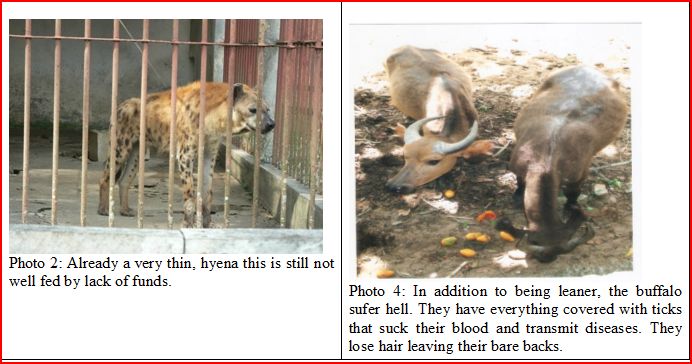
From March 2011, with the intensity of deadly clashes in the city of Abidjan, the situation has worsened to the zoo. The list of groups of animals at the zoo with the numbers of individuals of each of these animals is presented in Table 1. The numbers of animals per species at the zoo in Abidjan are not high and they are generally less than 10 individuals, except in mangabeys and chimpanzees, which slightly exceed this figure and especially the crocodiles that are 54 individuals. Although the numbers of each species are few, the animals were divided into 25 different species. There are 8 species of animals (civet cat, peacock, squirrel, pygmy hippo, vulture, elephant, green and patas monkeys) that are now represented at the zoo by a single individual. Inadequate food that we make and especially the lack of animal protein for some animals such as carnivores caused pronounced weight loss in most of them in March (photo 1, 2, 4).

In April the situation in Abidjan Zoo became even worse and we went there April 12, 2011 to support the animals as we had always done. On our arrival, we met a few agents makes us the inventory we found the weight loss yet the only lioness depth remaining (photo5) and death of some animals still in cages (photos 6, 7) as agents in place could not get into the cage in question due to lack of technical means. Indeed, to enter the cages must obviously break the lock (the key with some agents having remained absent) and after replacement.

Ultimately, in March, the zoo had 151 animals and 112 in April. What constitutes a loss of 39 animals representing a loss of 25.85% of the total with the disappearance of four species namely lions, baboons, monkeys and antelopes Campbell. three-week crisis. Note the total disappearance of some important species such as lions, baboons, antelopes and monkeys Campbell. Some animals like pythons, alligators and crocodiles have suffered no loss. Under analysis in Table 1 and Figure 1 indicates that frugivorous and carnivorous animals in the zoo have suffered the adverse effects of this crisis then herbivores and the group of reptiles have coped. Chimpanzees, monkeys, baboons and patas are the main frugivorous zoo, as lions, hyenas, civets to the kites and vultures are the group of carnivores at the zoo. These two groups have daily needs of food and therefore food shortage for a long time, it can be fatal, the group of scavengers that are the crocodiles and alligators as they only eat dead chicken. This group and reptiles such as pythons have not had any problems because they have a slow regulation and may remain for several days without eating.

With regard to our actions in the light of this, initially, have been to give money to the officers to remove all dead animals cages. Of the two dead chimpanzees, the male was the only male in the zoo know copulate and had managed to pregnant females (Arm-length on the picture 12 with her baby) and a baby is born now aged three. Chimpanzees, copulation is a social act that is learned with others and
like all the chimpanzees at the zoo were definitely torn wilderness to their very young mother can not remember many things. We found more emaciated the animals, more sad and sick from lack of food (photos 9, 10, 10, 12) and agents as desperate and very concerned about their fate. We immediately searched for food for the animals still alive. This was possible thanks to the officers who accompanied us in the races since it was difficult or almost impossible to move alone in the streets of Abidjan at this time. With soaring prices on the market during the crisis, our money ran out quickly, so we appealed to everyone through the radio (radioTCI) and good wishes and some of our partners. One of our partners and a willingness to have responded favorably, which helped us save the lives of the zoo animal remains to this day.

In order to prevent, other problems we have seen fit to inform the competent authorities as the entire administration of the zoo is absent until the time of writing this report (May 7, 2011). According to officials, the Director will be absent for months. The zoo was thus left to his own yet he had to survive under these key educational, recreational and its role in conservation. We took the risk to act on animals in cages, deprived of all freedom and all. Indeed, some resident agents around the zoo have assured the permanence at the height of the crisis. They braved all dangers by ensuring their duties of feeding the animals. In the words of one who takes care of the elephant, each day he risked his life to cutting grass to feed it, he said that an elephant must always have his daily ration even if it is insufficient if this large mammal falls and not rise again. And knowing this, he was faithful to his task well within the scope of bullets. Early four officers have ensured a minimum service, with no resources, they cut the grass around the zoo to feed animals they could eat. Thus, some animals such as hyenas, civets, sea turtles have adapted to this crisis (food for these animals) and become more frugivorous (photo 13, 14). This is a change of diet. Indeed, these animals eat meat, respectively fish and consumers have become more fruit. In the space of three weeks (from March 26 to April 12, 2011), the zoo has undergone huge losses, then follow the balance sheet.

B-state current daily receipts:

Figure 4: Table showing the total revenue obtained from daily
April 16, 2011 to May 8, 2011


In one month 124 visitors have been to see the animals at the zoo. The number of visitors is about 4 guests with a recipe 940Fcfa average per day. This amount is equivalent to 6 or 10 bananas fresh papaya. The daily receipts obtained clearly show the impact of the crisis on the entry of the daily receipts for the expenses of the zoo. Officers used the money to pay for their transportation to look for dead chickens at Coco service in the town of Abobo.

C- The current status of staff at the zoo:
In the words of the agents, they have not received their salary for four months. And yet they remained faithful to their post during this crisis in the care of animals. The agents to date are
13 in number. These are: They are: Blue Marcellin Oulaï Boniface Sie Kam, Kouakou Felix Akissi Augustine, Jerome Bla, Oulaï Alexis, André ZOH, Topka Firmin, Kouame Kouadio, Sela Rodrigue, Bert.

D- State vehicle zoo:

In February 2011, the Director had informed us that he was no longer in possession of the vehicle at the zoo after the massive displacement of Abobo. Since that time we have used metered taxis to transport food animals. Thursday, April 6, reporting the vehicle was parked it would agents in the town of Abobo and officers went noticed. The costs for this are around 40 000Cfa and seen all the current expenses, we are obliged to ask for help.

E- Partners helping the zoo:
This special action that we carry for a month is the work of certain Ivorian and European goodwill, NGOs and private companies. We thank them. Special thanks to Mrs. Kante Aïha its support of this action and collaboration and net franchise and Mr. Michael Kribi Afreek group for its expertise in web communication.

F- Urgent at Zoo:

 A vehicle for liaison between the different sites of food supplies;

 The presence of a veterinarian for the health of animals to avoid possible dead;

 The need for food for all animals. Indeed, frugivores need for example an average of five cases per day plus a banana boxes of mangoes, a total of 40 000 to 5000Fcfa if we want to feed the animals. As for primates, they need 20 to 30 kg of meat per day. And fish from about 15 to 20kg per day.

 You have to pay agents to enable them to resume work properly.


Conclusion:

This difficult situation through the zoo shows both the image of the Ivorian society is facing many problems and also the mismanagement of our leaders. Today the zoo is back in politics and we see the results are paying the consequences. The zoo is Life, Joy, Nature. The zoo should make us dream, share the love. Not the zoo is not a place of bitterness and even a cemetery. ZOO Let the real men, those who love him and who know the importance. We want more men interested in their own people and full of shameless self-interest. The State play its part and ask to account those who have taken the responsibility to manage. Love the zoo is to love life...


Recommendations:

 Designing brochures, flyers and posters to give key information to target populations and also inform them about the activities we organize.
Hold open days at Abidjan Zoo;
 Organizing drawing competitions, debates, or poems to help target populations to better understand animals and their roles in nature;
 Writing articles or letters to newspapers or newsletters;
 Publish local extension works to accompany the actions of environmental education (eg information booklet on rare vertebrates and dangers on endangered plants ...);
Ensure regular medical visits to the animals through a contract with a veterinary practice, organizing a vaccination program for officers;
 Organize meetings of Environmental Education (Contact with schools, building restoration (already identified need roofing and painting) into a screening room and education);
 Conduct training sessions or retraining of supervisors for better tracking of animals;
 Research funding and international organizations to integrate the Zoo to international funding programs (like the NGO ACB-CI;
 Sales of gadgets bearing the likeness of various animals present;
 Promote scientific research at the zoo in zoology, veterinary science, social science ...;

 Ensure regular pay agents;
 Creation of fields in the space not usable at the zoo to supplement the diet of animals.

Table 1: List of live and dead animals at the zoo with their staff in a
months (from March 26 to April 12, 2011) Crisis


Figure 1: Diagram showing the reduction of animals in three weeks function of diet


***


For regular updated Zoo News, Views, Reviews and Vacancies please visit
 Zoo News Digest
on


Please Visit
The Zoo Professionals Book Store
if you are looking for a book. This is an Amazon affiliate and you will get a good deal

also
 you can subscribe to the largest and longest established zoo related ezine
by clicking
HERE


To advertise in Zoo News Digest please see HERE 


Money for Free
If you can write, you can earn. Write about what you like or what you know about. Build up a passive income which will earn you money daily. No catch, no charge. Click on the link below and you could start earning today


HubPages


Wednesday, May 11, 2011

Water For Elephants


They say a picture is worth a thousand words. I don't doubt it but what if those thousand words were lies? It is possible. Camera angle, composure and filters can turn a happy scene into tragic one. Video footage is no different, especially as it can be spliced and edited.

Words....yes words. In reference to the Ankus I call it an Ankus. I always have because that is what it is called. The animal rights call it a 'Bull Hook' because it makes it sound like a nasty weapon of torture.... which the Ankus most definitely is not when used correctly (read Elephant Care).

Now don't get me wrong here. I am against the abuse and cruelty of any animals and the recent Anne The Elephant business I found made me very angry. I am so glad that she was 'rescued'. I do not know Gary and Kari Johnson or anything about them really but they do ask a very valid question "If there was truly any abuse going on why wait six minutes, much less six years?"....and it is for that reason that Zoo News Digest is giving coverage to their statement which you can read below. I have watched the controversial video put out by Animal Defenders International and I admit that it is upsetting especially with the accompanying soundtrack. I will also admit that I do not like elephants being taught to do headstands, handstands, rearing stands, podium stands and similar. I am not a circus fan. I also don't like the way that the ankus is being used in several of the clips. So I am definitely not offering a defence here but... The video IS heavily edited leaving me sceptical of the whole thing and the question remains, why if this 'abuse' was known about was it not brought to the world's attention before?

Comments if you like below this Zoo News Digest blog post. Please note that anonymous posts will not be approved and will be deleted.


STATEMENT BY HAVE TRUNK WILL TRAVEL Inc
We are so disappointed that the wonderful opportunity presented by Tai's role in "Water for Elephants" to raise awareness and funds for elephant conservation and Elephant Endotheliotropic Herpesvirus (EEHV) is being exploited by animal rights extremist groups.

We are unwavering in our commitment to elephants. We stand by our care and training methods. We are proud of our contributions to elephant welfare and conservation.

Animal rights extremist groups are using Tai’s role in Water for Elephants as a vehicle to take advantage of her celebrity to further their efforts to remove elephants and all exotic animals from entertainment.

These groups have no basis of knowledge or experience working with elephants. They have an agenda and a history of using less than honest means to achieve their goals.

The video shows heavily edited and very short snippets, obviously taken surreptitiously six years ago, purporting mistreatment of our elephants.

If there was truly any abuse going on why wait six minutes, much less six years?

None of the footage being shown was taken during Tai’s training for Water for Elephants.

Tai’s celebrity and the popularity of the movie seem to be the motivation for the extremist groups to garner publicity for themselves and their cause.

As our work in the movie proves you can make something look like anything to suit your purposes. That is why they call it “movie magic”. Rest assured that we will continue to provide Tai and all of our elephants with the love and excellent care they deserve.

Gary and Kari Johnson

Have Trunk Will Travel, Inc.


***


For regular updated Zoo News, Views, Reviews and Vacancies please visit
 Zoo News Digest
on


Please Visit
The Zoo Professionals Book Store
if you are looking for a book. This is an Amazon affiliate and you will get a good deal

also
 you can subscribe to the largest and longest established zoo related ezine
by clicking
HERE


To advertise in Zoo News Digest please see HERE 


Money for Free
If you can write, you can earn. Write about what you like or what you know about. Build up a passive income which will earn you money daily. No catch, no charge. Click on the link below and you could start earning today


HubPages


Big Changes at Al Wabra Wildlife Preservation


Big Changes at Al Wabra Wildlife Preservation

As of the 1st August 2011 Sven and Catrin Hammer have resigned from their posts of Director and Mammal Curator at Al Wabra Wildlife Preservation. After eleven years heading one of the most exciting and important collections in the Middle East (and the world) the two dedicated zoologists have felt the urge to return home to Germany where they will take on new challenges in the Naturschutz-Tierpark Goerlitz.

I am sure that all friends and colleagues will wish Sven and Catrin well in their new posts and hope that the invaluable work carried out in Al Wabra will continue smoothly.


***


For regular updated Zoo News, Views, Reviews and Vacancies please visit
 Zoo News Digest
on


Please Visit
The Zoo Professionals Book Store
if you are looking for a book. This is an Amazon affiliate and you will get a good deal

also
 you can subscribe to the largest and longest established zoo related ezine
by clicking
HERE


To advertise in Zoo News Digest please see HERE 


Money for Free
If you can write, you can earn. Write about what you like or what you know about. Build up a passive income which will earn you money daily. No catch, no charge. Click on the link below and you could start earning today


HubPages


Zoo membership won't be kept in a cage any longer


Zoo membership won't be kept in a cage any longer

Is history about to repeat itself at crisis-hit Edinburgh Zoo, asks John Barrett

There used to be a zoo in the north of Edinburgh, near the site of the Royal Botanic Gardens, which lasted for only 18 years from 1839. It was popular, and was called the Royal Edinburgh Zoological Gardens. It closed after it was sold off to a commercial concern that was just interested in making money. It appears history might be about to repeat itself.

In recent years the zoo appears to have lurched from crisis to crisis. Currently, many members feel that they have been left in the dark for too long and a group has demanded an extraordinary general meeting, at which a vote of no confidence in the chairman and board will be discussed.

The meeting will take place this Thursday and interest from the estimated 23,000 members has already resulted in the venue being changed from the zoo itself to a larger venue at Murrayfield Stadium.

The importance of the Royal Zoological Society of Scotland (RZSS), which runs Edinburgh Zoo, spreads throughout the country and beyond.

As well as providing a family day out, it has responsibilities for conservation, education and research projects, both in Scotland and internationally.

As a life member, each year I am sent the annual report showing the many good things going on, but there is also a clear risk of the organisation spreading itself too thinly.

The zoo has often trumpeted its multi-million pound masterplan, but anyone who had the nerve to question the need to sell land for development was told that they were putting this plan at risk.

Many members have told me that they feel the board and former chief executive overstepped the mark regarding disposing of and developing land that was given to the RZSS for the specific use of the zoo.

The performance of the board must be held up to close scrutiny. They need to demonstrate exactly what actions they have taken in recent years to ensure the organisation was well managed. They need to show what their value actually was.

I have no doubt that the individual board members have a range of skills and talents, but I am not convinced the board delivers the needs and aspirations of the membership.

When I made my maiden speech in parliament, I proudly mentioned the fact that I probably represented more penguins than any other MP in the UK. Sadly, the once top-class enclosure now looks neglected.

It is important to the local and Scottish economy as one of the top-ranking tourist attractions in the country and it is on one of the most beautiful zoo sites in the world on Co.....


Read More Here: John Barrett: Zoo membership won't be kept in a cage any longer - Scotsman.com News


***


For regular updated Zoo News, Views, Reviews and Vacancies please visit
 Zoo News Digest
on


Please Visit
The Zoo Professionals Book Store
if you are looking for a book. This is an Amazon affiliate and you will get a good deal

also
 you can subscribe to the largest and longest established zoo related ezine
by clicking
HERE


To advertise in Zoo News Digest please see HERE 


Money for Free
If you can write, you can earn. Write about what you like or what you know about. Build up a passive income which will earn you money daily. No catch, no charge. Click on the link below and you could start earning today


HubPages


Tuesday, May 10, 2011

Zoo News Digest 8th - 10th May 2011 (Zoo News 749)

Zoo News Digest 8th - 10th May 2011 (Zoo News 749)

Tchimpounga Chimpanzee Rehabilitation Center


Peter Dickinson


Dear Colleague,

Well done Cincinnati Zoo, solar is definitely the way to go.

The San Diego Zoo story relating to gene mapping was good news. So important and goes hand in hand with the work of the frozen zoo. Cloning too where necessary. Then there was the story from Dubai who are apparantly planning to clone the Arabian Oryx. One wonders why. A clone is an identical twin. I really cannot see how an identical twin of an animal that breeds so readily and is so numerous in captivity is going to help anything. Now the Arabian Leopard is a different case. There are limited numbers in captivity and it would probably help to replicate some animals and freeze embryos till a later date. What is really needed is greater cooperation with the management. This was stated by Sheikh Butti Bin Juma Al Maktoum only recently (see http://zoonewsdigest.blogspot.com/2011/04/zoo-news-digest-22nd-24th-april-2011.html). With regards to this magnificent cat there has been stalwart work done by and continuing in the Breeding Centre for Endangered Arabian Wildlife in Sharjah.

Which brings me on to the Arabian Tiger. Yes I agree cloning and every other available means possible should be carried out to preserve this rare beast. (check the links) I have never seen one. I wonder who has.

Really, honestly and truly I could not give a damn what a baboon did to Wayne Rooneys car. This hot and seemingly important news item appeared in many papers. I won't give more than these three sentences and won't bother with the link.

"Pet monkey attacks owner in bed"...this story made me so very angry. It was the statement by the person now holding the unfortunate animal....""He should have had fangs removed, that's what makes him so dangerous is those fangs," said Jeter."... What the $%%$*@? And now this ignorant woman is responsible for his well being she is going to have him neutered. Why neutered? There are alternatives. People like this should not have anything to do with animals.

Which moves me directly onto the subject of slum Malaysian Zoos. The story here "Zoo cruelty: Embas must quit, says senator" concerns me slightly because they make the suggestion that "the government change the management of Department of Wildlife and National Parks (Perhilitan) to allow animal conservationists to run it." Now the distinction must be immediately made to 'zoo animal conservationists' otherwise we are going to have a bunch of know nothing care less anti-zoo's getting in on the act. Whereas I don't defend this zoo and know next to nothing about it apart from seeing a few photographs I would like to know more about the "public exhibitions featuring his tigers". There can be both good and bad in 'public exhibitions' and it does not make itself clear here.

Now to the subject of Polar Bears in Chiang Mai Zoo which were not actually mentioned in the news this week. Check out the first link though and it may well be that Polar Bears would be a lot better off living in Chiang Mai. They are already living in Singapore Zoo and Bangkok Safari World of course, which, if temperature is the main consideration then Chiang Mai offers a fractionally cooler climate. Both Singapore and Bangkok offer cooled accommodation of course, as would Chiang Mai. Chiang Mai already has the Giant Pandas in cool climate housing. I don't recollect a word of protest about them, though there may well have been. In terms of space I still maintain it is quality of space rather than quantity. Temperature and space appear to be the big topics of the day as far as captive animals go at the moment be they Elephants or Polar Bears. It will be everything else next.

Political correctness has moved on from being stupid to complete and utter insanity. Now they are saying that it is wrong to call a Pet a Pet!!!! Just what planet did these people come off. I am a Geordie (near as dammit) and I call women 'pet' all of the time. It is a term of polite affection. I also call dogs and cats and gerbils pets because that is what they are. There is no connection between the two. I have never ever had a woman offended by my use of the term and never a complaint from any cat, dog or gerbil either. It is insane. I wonder how these PC idiots would get on in Derbyshire where everyone is called "Duck" or "Duckie" regardless of what sex they are. Again, polite affection....and I doubt the ducks would complain either.


****
Please show your support for Zoo News Digest with a small annual donation. It is quick, easy and safe. Simply click on the donate button towards the top of the blog page. Thank you. Zoo News Digest is my only job and I work hard at it daily. Any help you give is appreciated and ensures that I can continue to keep you informed of what is going on in the zoo world. The ZooNews Digest continues to be read more often by more staff in more zoos than any other publication.


Looking for a job?
Check out 
Got one to advertise? email me

 
This blog has readers from 151+ countries: Afghanistan, Algeria, Antigua and Barbuda, Argentina, Australia, Austria, Bahamas, Bahrain, Bangladesh, Barbados, Belarus, Belgium, Belize, Benin, Bhutan, Bolivia, Bosnia and Herzegovina, Botswana, Brazil, Brunei, Bulgaria, Burkina Faso, Cambodia, Cameroon, Canada, Cayman Islands, Chile, China, Colombia, Costa Rica, Cote D’Ivoire, Croatia, Cuba, Cyprus, Czech Republic, Denmark, Dominican Republic, Ecuador, Egypt, Eire, England, Estonia, Ethiopia, Fiji, Finland, France, French Guiana, Gambia, Georgia, Germany, Ghana, Greece, Grenada, Guadeloupe, Guam, Guatemala, Guyana, Haiti, Hong Kong, Hungary, Iceland, India, Indonesia, Iran, Iraq, Israel, Italy, Jamaica, Japan, Jordan, Kazakhstan, Kenya, Kuwait, Lapland, Lao, Latvia, Lebanon, Lithuania, Luxembourg, Macedonia, Madagascar, Malawi, Malaysia, Maldives, Malta, Mauritius, Mexico, Moldova, Monaco, Mongolia, Morocco, Montenegro, Montserrat, Myanmar, Namibia, Nepal, Netherlands, New Zealand, Nigeria, Northern Ireland, Northern Mariana Islands, Norway, Oman, Pakistan, Panama, Paraguay, Peru, Philippines, Poland, Portugal, Puerto Rico, Qatar, Reunion, Romania, Russia, Rwanda, Saint Kitts and Nevis, Saint Lucia, Saudi Arabia, Scotland, Senegal, Serbia, Singapore, Slovakia, Slovenia, South Africa, South Korea, Spain, Sri Lanka, Sudan, Sweden, Switzerland, Taiwan, Tanzania, Thailand, Togo, Trinidad and Tobago, Tunisia, Turkey, Uganda, Ukraine, United Arab Emirates, United States, Uruguay, US Virgin Islands, Uzbekistan, Vietnam, Wales, Yemen, Zambia. 

Is your meeting/conference/symposium listed here?http://zoosymposia.blogspot.com/
If not why not? ZooNews Digest is read by more zoo people than any other similar publication. I will advertise up till the event.
Please visit the
if you are looking for books for yourself or as gifts.

****************************************************************************

On with links: 

Pollutants taking toll on polar bears: researchers
Persistent organic pollutants used in industry are changing the genitals and bones of polar bears in East Greenland, says a Danish wildlife veterinarian and toxicologist.
"Shrinking balls and degraded bones," linked to the presence of pesticides and flame retardants in the Arctic, are likely to affect the animals' fertility and reproductive success, said Christian Sonne at last week's conference on Arctic climate change and pollution in Copenhagen.
These impacts are "not just" affecting polar bears, said Sonne who works at the National Environmental Research Institute of Denmark.
People, as well as other animals, in Canada's Arctic may also be at risk of similar effects from these pollutants, although the toxic "cocktail" becomes somewhat lower as you head west from Greenland across the Arctic region, he said.
Polar bears from East Greenland are among the most polluted species in the Arctic because their diet depends on contaminant-loaded blubber from ringed and bearded seals.
Add a warming climate to this mix, and the combined effect may be disastrous for the survival of the species.
Sonne's latest research shows East Greenland
http://www.montrealgazette.com/health/Pollutants+taking+toll+polar+bears+researchers/4751619/story.html


Al Wafd News paper today 10 May 2011: HEADING: ORANGUTAN DIES IN GIZA ZOO AND YET THE MANAGEMENT STATES IT IS ALIVE


الوفد - مات إنسان الغابة في حديقة الحيوان و المسئولون مصممون على انه حي

Check out Facebook for more detail http://www.facebook.com/pages/ZooNews-Digest/41410063216?ref=nf


Calling your Fido your 'pet' may be politically incorrect
If you own a dog or a cat, or even iguana or a goldfish, you call them your pet, right? Well it turns out, you might be politically incorrect! We may want to start calling our furry, or scaley, friends, "animal companions."
Our pets, how we pamper them. But the Journal of Animal Ethics finds the word "pet" derogatory. They'd prefer animal companion.
Certainly for most dog owners they see their Fido's as something more than a pet. But it's not just domestic animal companions they'd like us to
http://www.todaysthv.com/news/article/156689/70/Calling-your-Fido-your-pet-may-be-politically-incorrect


Solar Panels Installed at Cincinnati Zoo
The Cincinnati Zoo has more than 6,000 new additions. They're not furry, but they are green. The zoo unveiled a canopy of solar panels this morning, and as Local 12 news reporter Angenette Levy tells us, it's setting the zoo apart from all of the others.
The Cincinnati Zoo is now the greenest zoo in the nation, thanks in large part to these 6,400 solar panels in the zoo's Vine Street parking lot. On a sunny day like today, when the A/C and the heat aren't running for the zoo's critters, the solar panels are producing all of the energy the zoo needs and then some. That extra energy is then returned to the grid.
Annually, the panels will produce about 20 percent of the zoo's energy. It's clean and reduces the zoo's carbon emissions. "In very green towns, like Seattle, Portland, San Francisco, they are green with envy of what we're pulling off in Cincinnati, by God, Ohio."
Solar panels aren't cheap. This is a $12 million project, but the zoo didn't pay for it. Melink, a company based in Milford, Oh., owns and built the canopy, and PNC Bank provided reasonable financing. Energy and tax credits also helped with the cost. The zoo buys the energy the panels produce. The cost doesn't fluctuate like other energy sources. Zoo Executive Director Thane Maynard says the zoo hopes to influence others to go green. "The problem
http://www.local12.com/news/local/story/Solar-Panels-Installed-at-Cincinnati-Zoo/hppH8s1uA0KD22yhFGNsyQ.cspx


Worthington: Tennessee refuge right place for zoo's elephants (READ THE ARTICLE COMMENTS)
A weekend column by the inimitable Joe Warmington, scolded that “phony American activists” were seeking to “hijack” the elephants at Toronto Zoo and send them to an elephant sanctuary in Tennessee.
Joe’s heart is in the right place — but I think he is wrong.
One doesn’t have to be a “politically-correct wacko” (Joe’s term) to realize that the elephant exhibit at the zoo is haywire. There are three elephants, Thika, Toka and Iringa, confined to a 40-square metre pen in winter, and a paddock outside in summer.
A disquieting reality is that four elephants have died in the last five years, and seven since 1984. Most were under 40 years old.
Even zoo people acknowledge that Toronto’s climate is not conducive to elephants, especially as they grow older and become arthritic. Detroit’s zoo decided in 2004 to no longer exhibit elephants because of Michigan’s cold winters and the lack of “the appropriate physical and social environment” for captive elephants.
Three Toronto Zoo elephants died within 14 months — Tara, Tessa and Tequila. Each death was a traumatic shock for zoo staff who were attached to the animals, recognized their individual personalities, and regarded them as friends.
Everyone connected with the zoo knows something has to be done as the three remaining elephants are growing older. Estimates range from $15 to $30 million to build suitable facilities, and that sort of money simply isn’t available.
An alternative is to donate the elephants to an elephant sanctuary in Tennessee, where a couple of dozen “retired” circus and zoo elephants roam freely on 2,700
http://www.torontosun.com/2011/05/09/worthington-tennessee-refuge-right-place-for-zoos-elephants


ZooMontana closes for week after insurance company drops zoo's liability policy
ZooMontana’s liability insurance policy was canceled on Monday, and the zoo will be closed for the rest of the week.
Zoo Board President Ian McDonald said the insurance agent, Taylor-Leavitt Insurance, called McDonald on Monday about the policy.
The policy is carried by Philadelphia Insurance, which dropped the zoo.
Taylor-Leavitt is working with the zoo to find a new insurance carrier.
“They said the payment was late, but it was made,” McDonald said. “Now they are sending the money back and canceling the policy.”
McDonald said he tried obtaining a blanket insurance policy for the week, but no such policy exists.
“It’s my goal to get a policy in place by the end of the week here,” McDonald said.
Accounts of what happened differed among the zoo board and staff.
Zoo Director Jackie Worstell, who submitted her resignation in February, but has since said she may stay, said the zoo did not have enough money to make payments this winter. Word of the zoo’s financial struggles became public in February.
“We are all paid up now, but the problem is the insurance company just right now doesn’t have faith in knowing we would be a good client,” Worstell said. “They’ve be
http://billingsgazette.com/news/local/article_c2fe4394-94f0-5337-84a3-94f704fc91bf.html


Dubai to clone Oryx and Arabian leopard
Project follows success of world’s first cloned camel
Dubai is on the verge of launching another landmark project to clone the endangered Oyrx and Arabian Leopard after succeeding in producing the world’s first cloned camel, a newspaper said on Saturday.
The camel breeding centre said the plan is part of a major project to restore ecological balance and increase the number of endangered animals in the region, including the Oryx, Arabian Leopard and Arabian Tiger, the Dubai-based Arabic language daily 'Emarat Al Youm' said.
“The centre is now preparing to receive 10 more cloned camels by the end of this year or early next year,” said Dr Nassar Ahmed Wani, project director at the centre, the world’s first breeding institution to clone a camel.
“After our success in cloning the world’s first camel, we are now planning to clone endangered animals including Oryx, Arabian Leopard and Arabian Tiger..,” he was quoted by the
http://www.emirates247.com/news/emirates/dubai-to-clone-oryx-and-arabian-leopard-2011-05-07-1.389795


Scientists in Dubai plan 'frozen zoo' for cloning
Scientists in Dubai are keeping a repository of frozen cells they hope can one day be used to create cloned animals that can repopulate species facing the threat of extinction.
Experts at the Camel Reproduction Centre, in al Aweer, are in the initial stages of putting together a "frozen zoo" of cells taken from endangered species.
It is hoped that those cells will bolster dwindling stocks of native species such as the Arabian leopard, the oryx and the tahr, or mountain goat.
"Cloning can help preserve species which are threatened with extinction," said Dr Nisar Wani, the head of the reproductive biology lab at the centre. "We can store millions and millions of cells here. So if tomorrow anything happens to those endangered animals and they become extinct, we can produce millions of embryos from those cells."
The team will next month celebrate the second birthday of the world's first cloned camel, named Injaz, meaning "success" in Arabic. Since then, there have been multiple births of cloned camels
http://www.thenational.ae/news/uae-news/scientists-in-dubai-plan-frozen-zoo-for-cloning?pageCount=0


Cloning key to saving UAE’s most endangered animals: scientist
DUBAI — The UAE’s most endangered species could be saved from extinction by a revolutionary new cloning technique being developed at a fertility lab in Dubai.
Dr Nisar Wani, the scientist behind the creation of the world’s first cloned camel, believes the technology exists to ensure the survival of threatened species such as the Arabian Oryx or the Arabian Leopard.
The technique, known as interspecies nuclear transfer, would for example, involve the cells of an Oryx being inserted into the womb of a goat for incubation.
“We have many endangered animals in the UAE,” Dr Wani told the Khaleej Times during an interview at the Camel Reproduction Centre in Dubai.
“We can use the cells of these animals and use another species, from the same family, as a surrogate mother.”
In April last year, the centre attracted international attention for being the first lab in the world to have cloned a camel. It was named ‘Injaz’, or ‘achievement’
http://www.khaleejtimes.com/DisplayArticleNew.asp?xfile=/data/theuae/2010/June/theuae_June376.xml§ion=theuae


New England Aquarium closed after crack is found in tank
The New England Aquarium has been closed so repairs can be made to a crack in its largest tank, officials said.
Officials said the crack was near the top of the giant ocean tank, which is located at the core of the aquarium, and the water level was being lowered so repairs could be made.
There is no danger to either animals or humans, said Jane Wolfson, vice president of marketing and communications at the aquarium.
The tank is made of triple-layered glass and the crack was found in only one of the layers, she said.
The tank contains 200,000 gallons of water. It is 23 feet deep, 40 feet wide, and is home to more than 600 denizens of the deep, including
http://www.boston.com/news/local/breaking_news/2011/05/new_england_aqu_2.html


Extinction Likely for World's Rarest Bear Subspecies
The May 3 death of a Marsican brown bear (Ursus arctos marsicanus) has put the world's rarest bear subspecies one step closer to extinction. Just 50 or so of the animals remain in two of Italy's national parks, a population so small that the bears are "below the threshold of survival," Giuseppe Rossi, head of the National Park of Abruzzo, Lazio, and Molise, told The Christian Science Monitor.
The bear killed this week was likely struck by a car, an example of the increased bear-human conflict that has halved the population from 100 animals since the 1980s. In addition to traffic fatalities, poachers used poison to kill three bears in 2007, including a cub and his famous father named Bernardo, who was known for casually strolling around the streets of local villages. A female
http://www.scientificamerican.com/blog/post.cfm?id=extinction-likely-for-worlds-rarest-2011-05-06


Life after pandas leave
Ma Xujue has never been so unsure about the future before, even when most of his properties were destroyed when an 8.0-magnitude earthquake jolted his hometown of Wolong in southwest China three years ago.
The region, rich in vegetation and covering some 200,000 hectares in west Sichuan Province, is better known as the "hometown" of the endangered giant pandas, with 10 percent of the world's wild pandas, and more than 60 percent of the captive-bred panda population, living here.
But now, the 48-year-old farmer and his fellow villagers in Wolong Town will no longer enjoy the benefits and pride of being "panda neighbors", as the quake-hit China Conservation and Research Center for Giant Pandas, based in the town, plans to move to a safer location with all of its caged pandas.
The new center, set in a flat mountainside area called Shenshuping, is about 22 kilometers northeast of its original location. In theory, it's still in the Wolong Natural Reserve, the first and largest of its kind in China for the protection of pandas. However, it is outside of the domain of Wolong Town in the neighboring township of Gengda.
Sponored by the government of the Hong Kong Special Administrative
http://news.xinhuanet.com/english2010/indepth/2011-05/07/c_13863499.htm


Edinburgh Zoo chief: I've been open and honest
EDINBURGH Zoo's suspended chief executive today broke his silence and vowed to return to work, but not as the top man.
In an exclusive interview with the Evening News, acting chief executive Gary Wilson said he had been "devastated" by a damning dossier of allegations that led him to be suspended in March. But he said he would not let the "malicious" allegations grind him down and pledged total commitment to the zoo.
He also said he wanted to "fix the problems at the zoo" and said the possible leasing of the attraction to Spanish company Parques Reunidos, as revealed in the Evening News last week, had "its pros and cons".
Asked if he would attend an emergency meeting at Murrayfield Stadium he said he would, if asked.
The chairman of the Royal Zoological Society of Scotland's (RZSS) executive board, Donald Emslie, has confirmed that robust internal and external investigations into ten years' worth of documents had proved every one of the allegations against Mr Wilson to be unfounded.
Mr Wilson said: "I remain fully committed to the organisation and understand what they had to do in relation to these allegations. The board is a voluntary board and the time taken to conduct this investigation has been extensive. I would have liked it to have been quicker as it has caused a lot of frustration and tension, but I understand.
"I'd like to sit down with Donald Emslie and have a discussion about where we go from here."
Mr Wilson said he believed he knew who had made the anonymous allegations, which included accusations he siphoned money from accounts relating to the £4.5 million Budongo Trail to pay for a £50,000 balcony at his home in Dunblane.
It was also claimed he had stolen building materials and a promotional Fiat Panda car the zoo had planned to auction off for charity.
He added: "When I found out the dossier had been handed in against me, I was devastated. I've had nothing to hide and I was very open with the board, shared with them everything they wanted and more. They didn't ask for my bank statements or documents relating to how I paid my mortgage, but I handed them over.
"There is nothing sinister going on with my house and the only reason my balcony looks like the Budongo Trail is because I designed both of them. I have strong suspicions, but only suspicious, about who did this to me. I can't prove it."
Two weeks after Mr Wilson was suspended, another director, Iain Valentine, who was in charge of animals, research and conservation, was also suspended following allegations of financial impropriety.
On the same day, Anthony McReavy, director of development, was sacked for "bringing the society into disrep
http://news.scotsman.com/scotland/Edinburgh-Zoo-chief-Ive-been.6765159.jp


Zoo leads effort to map genes of 10,000 animals
After 13 years in the San Diego Zoo, the echidna (pronounced ih-KID-na) succumbed to an unknown illness at the age of 27, far short of his expected 50-year life span.
Now, researchers are making sure the animal’s death wasn’t in vain.
At the world’s largest genetic testing facility in Beijing, Eddie’s preserved cells are being used to create the first map of an echidna’s biological source code, which could help save the endangered species from extinction.
DNA from a San Diego Zoo echidna, like this one named Victor, is being mapped by a Chinese genetic sequencing center as part of the 10K Genome Projects. The Australian natives are one of only two mammals that lay eggs. At 57, Victor is the oldest living mammal at the zoo.
The work is part of the 10K Genome Project, an ambitious global effort to sequence the genes of 10,000 different kinds of vertebrae — mammals, birds, reptiles, amphibians and fishes — by 2015.
10K Genome Project participants with San Diego County ties Swazi, the matriarch of the elephant herd at the zoo’s Safari Park, was chosen for the 10K Genome project partly because she was specially trained to offer her ear to trainers to give blood samples. She arrived at the park in 2003 from a national park in the southern Africa country of Swaziland.
San Diego-based Illumina, the leading maker of genetic sequencing devices, is part of a group that will sequence this endangered miniature version of its much larger and better known cousin. About 3,000 animals remain in the wild, mostly in the West Africa nation of Liberia, according to the World Conservation Union.
Researchers in Beijing are mapping the DNA of this strange Australian creature with cells from an echidna that died at the San Diego Zoo in 1995. The marsupial’s tissue was preserved in a “frozen” zoo. Shown in the photo is Victor, a 57-year-old echidna that holds the distinction of being the oldest mammal at the zoo.
Working separately last year, two teams involving researchers from Illumina and the J. Craig Venter Institute in Torrey Pines sequenced several Tasmanian devils as part of an effort to save the marsupials from a contagious cancer that has already wiped out three-quarters of the animal’s wild population.
The Venter Institute is working on the sequence of these common Asian monkeys that have been used for decades in medical and biological testing.
In addition to the zoo, San Diego sequencing device maker Illumina and the J. Craig Venter Institute in Torrey Pines are contributing to the genomic mapping effort.
All of the data gathered by participants will be made available on the Internet, so researchers
http://www.signonsandiego.com/news/2011/may/09/sd-zoo-leading-effort-map-genes-10000-animals/


Bird missing from zoo's rain forest
Topeka Zoo director Brendan Wiley, in a news release issued Sunday, said a gray-necked Wood Rail bird appears to be missing from the rain forest of the zoo.
The bird, whose name is Ty, hatched in the rain forest this past summer. Ty was soon pulled from the exhibit and hand-raised by zoo staff members, so it is comfortable around people, Wiley said.
Wiley said a search of the rain forest, zoo grounds and surrounding areas have revealed no sign of the bird. Zoo staff members would
http://cjonline.com/news/2011-05-08/bird-missing-zoos-rain-forest


Shagged By A Rare Parrot


Russ Smith, zoo co-founder, dies at 69
Even after 30-plus years of nonstop giving, Russell Smith never got tired of volunteering at Binder Park Zoo.
"Any busy weekend, you could find Russ out in Africa talking to guests, or he loved standing at the Red Panda exhibit," said Jenny Barnett, zoo director of wildlife conservation.
Smith, 69, died at home Friday, according to information released by Shaw Funeral Home. Services are scheduled for 1 p.m. Friday.
Battle Creek police said they were called to the home at638 E. Minges Road at 1:18 p.m. Friday. Police said Smith had been cutting a tree in the front yard when a portion of the trunk fell and struck him.
Paramedics from Lifecare Ambulance attempted for 30 minutes to revive him, police said, but were unsuccessful.
"We're going to miss him a lot," Barnett said. "It's still a shock to me. It's going to be weird going to the zoo next week and not seeing Russ."
Smith, whom long-time friend and Binder Park Zoo President Greg Geise characterized as one of the zoo's founders, was heavily involved in the zoo's creation, operation, fundraising and promotion for decades.
Smith was a member of the Jaycees, a group which, in 1971, hatched the idea for a children's zoo in Battle
http://www.battlecreekenquirer.com/article/20110508/NEWS01/105080316


Region's first wild whale shark tagged off Qatari oil rig
Female whale shark is first to be tagged in the Arabian Gulf, marine biologist says
Scientists tagged the region's first wild whale shark off a Qatari oil rig last month in the hope of tracking the movements of whale sharks in the Arabian Gulf.
David Robinson, a Dubai-based marine biologist tagged the 8m long, female whale shark, named Amna on April 23. She is the first wild whale shark to be tagged in the Arabian Gulf.
Her movements will not be known for six months though, when the tag will dislodge automatically and once it pops to the surface will emit the information back to Robinson.
"This was the first whale shark we had attempted to tag for the study and luckily we were successful -and, with an 8m long female so we are delighted," Robinson told Gulf News.
Amna was tagged 90km offshore from mainland Qatar. As the founder of SharkWatch Arabia, Robinson is collecting
http://gulfnews.com/news/gulf/uae/environment/region-s-first-wild-whale-shark-tagged-off-qatari-oil-rig-1.804988


Knoxville Zoo's herpetology director, bog turtle advocate dies
Bern Tryon, the Knoxville Zoo director of herpetology and a champion for East Tennessee's endangered bog turtles, died Friday after a battle with cancer.
Tryon, 64, was Tennessee's best authority on bog turtles, which he studied and helped to save for 25 years. His dedication to the animals included developing a zoo program that hatches and later releases the turtles in native East Tennessee habitats. The conservation awards he earned for his work included one from the U.S. Fish and Wildlife Service.
"Bog turtle conservation in Tennessee is without a doubt his legacy. I don't know if it would be at all without him," said zoo Curator of Herpetology Phil Colclough.
A biology graduate of Gardner-Webb University, Tryon began his zoo career in 1971. He worked in herpetology departments at zoos in Atlanta, Fort Worth, Texas, and Houston before coming to Knoxville in 1984.
Some of Tryon's ashes will be scattered at a bog turtle
http://www.knoxnews.com/news/2011/may/10/knoxville-zoos-herpetology-director-bog-turtle/


Zoo pros learn about crocs at Alligator Farm
Molly Ebersold announced to Historic City News this morning that, for the eleventh year in a row, the St. Augustine Alligator Farm Zoological Park is hosting a renowned professional development course for herpetologists and zoo professionals around the country.
Commonly referred to as “Croc School”, the Crocodilian Biology and Captive Management Course is offered annually by the Association of Zoos and Aquariums.
The St. Augustine Alligator Farm is the logical choice for the course because it is the only place in the world in which students can study every existing species of crocodilian.
Courses will be presented by fourteen instructors. There will be twenty
http://www.historiccity.com/2011/staugustine/news/florida/zoo-pros-learn-crocs-alligator-farm-14407


Zoo cruelty: Embas must quit, says senator
A senator has asked Natural Resources and Environment Minister Douglas Uggah Embas to resign over the alleged mistreatment of animals in some zoos in the country.
Referring to recent news reports that zoo animals were kept in distressing conditions, DAP’s S Ramakrishnan said the minister had failed to act on the matter.
“He should resign if he really cares about animal welfare to make way for others who can do the job,” he said in a press statement.
He also suggested that the government change the management of Department of Wildlife and National Parks (Perhilitan) to allow animal conservationists to run it.
Last week, a private zookeeper in Senai invited NGOs and animal rights activists to spend time at his facility, saying he wanted to show that their accusations were baseless. However, he drew more flak when the Star published an interview with him on May 5.
Activists jumped on his admission that he held public exhibitions featuring his tigers. Perhilitan
http://www.freemalaysiatoday.com/2011/05/09/zoo-cruelty-embas-must-quit-says-senator/


Pueblo Zoo quietly settles lawsuit
The Pueblo Zoo is unwilling to disclose the terms on which it resolved a lawsuit in which two former employees alleged they were sexually harassed by a male groundskeeper.
A filing last week in the U.S. District Court case shows that the zoo and the ex-employees, Sandra Davis and Stephanie Pyles, recently resolved last year's lawsuit.
Pueblo Zoological Society Executive Director Jonnie McFarland said the nonprofit zoo has no comment.
Davis and Pyles alleged the male employee, who was not a defendant, improperly touched or kissed them and four other women on several
http://www.chieftain.com/news/local/pueblo-zoo-quietly-settles-lawsuit/article_0d9bca18-7928-11e0-abd7-001cc4c002e0.html


Pet monkey attacks owner in bed
Officers say man startled sleeping animal
Sammy, a 7-year-old, 30 pound male java macaque monkey paces in his cage. Occasionally he stops to pull on the bars or rattle the floorboards. Sammy is now in the care of Debbie Jeter, director of Bear Path Acres in Southampton County after attacking his owner two weeks ago.
"He should have had fangs removed, that's what makes him so dangerous is those fangs," said Jeter.
Surry County Animal Control officers said Sammy's owner was sleeping in a bed with the monkey when he accidentally rolled over onto it. Startled, Sammy bit the owner on his nose and arm. Now too afraid to keep him, Sammy spent 10 days in quarantine before coming to Bear Path Acres. The owners also relinquished a female macaque named Tara.
"They were loved, they were given
http://www.wavy.com/dpp/news/local_news/pet-monkey-attacks-owner-in-bed


Will boy George become a 'man'?
The plan of the guardians at the Rajiv Gandhi Zoological Park was more than sound: in order to increase the size of the wolf family at the park, get an adult wolf and put the zoo’s females in close proximity. After that, let their instincts take over.
The park’s management then got George, the wolf to impregnate the two she-wolves, Lucy and Rani, straight from the jungle — more specifically a centre run by social activist Prakash Amte in Hemalkasa. They had procured him two months back.
However, there is just one problem: George has never seen a she-wolf ever and the authorities are not sure how this ‘virgin boy’ would react. Actually, this great hope of captive breeding at the zoo is ten years old, a mature wolf who is probably set in his ways and is likely to resist new ideas, which may even include mating.
However, Navnath Nighot, the veterinary officer at the zoo is keeping his fingers crossed as in the case of animals instincts always seem to win the day, though George grew up eating vegetarian food like chappatis besides meat while in Amte’s care.
In any case, the story till now has been in George’s favour. For one, the two-month mandatory quarantine to ensure that he was healthy and would not pass on any ailment to Lucy and Rani and also get acquainted with the new environment, passed without any untoward incident.
The authorities at the park are happy that George made it through the quarantine period with flying colours and that he is the one. They have cleared him officially and have signed him on
http://www.punemirror.in/article/62/20110510201105100110058771a14ca19/Will-boy-George-become-a-man.html


*************************************************************************

Veterinary Work Wanted

I’m an Italian Wildlife Vet with a strong commitment in Wildlife Medicine and Biodiversity Protection.

I have been working as a free lance veterinarian for 8 years and, for 6 of them, I have been providing veterinary support in Wildlife Management and in Conservation projects, while working in Pet Veterinary Hospital with night and holiday shifts.

Particularly, I worked for 3,5 years in a full-time vet position, with an Italian non-profit wildlife hospital that take care about over 1,000 injured and orphaned wildlife patients each year (95% wild birds).

Recently I came back from the Ecuadorian Amazon jungle, after 1 year and half of veterinary service in “AmaZOOnico”, a Wildlife Rescue Centre for all Amazonian animals, more than ever non-human primates and birds, where I’ve learned to function in remote and adverse climate conditions and with basic equipment.

In these positions, my responsibilities have included design and implementation of preventative veterinary care programs; evaluation of animal health; diagnosis and medical/surgical treatment of illness and injury; capture and restraint of animals; euthanasia and necropsy; assessment and design of nutrition programs; sample collection, testing, database management and data analyses; problem analysis and resolution responsibilities; supervision and training of volunteers and the public about rehabilitation medicine and environmental and human health issues; development and maintenance of professional contacts with a variety of clients and partners involved in wildlife management; work with a wide variety of people; ability to organize, manage time and set priorities while meeting deadlines; ability to be flexible and shift priorities to meet departmental requirements.

Besides this, because I was always working for poor No-Profit Organization, I’m used to work in a multitasking environment (from cleaning cages to the development and maintenance of professional contacts) and this fits well with my flexibility and has allowed me to gain abilities also as wildlife rehabilitator and veterinary nurse, for example, and, as natural resource manager.

I’m looking for a job, as freelance or full contracted, that allows me to continue my career in the field of the Biodiversity Protection.

The Northern Hemisphere’s animals are my first preference but I know that it’s quite hard to find the perfect job and, by the way, it would be just wonderful even if I could continue to work in the field of the Biodiversity Conservation, no mattering the species of the animals and in which place of the world!

What I can offer, is high flexibility, willingness to travel, ability to work in a multi-cultural environment, full and continuous training, ability to work in the field as well as willingness to gain experience in endoscopy and echography as needs. Italian mother tongue and working knowledge of Spanish and English.

Dr Sonja Ciccaglione

For further details, please e-mail: sonja.c@alice.it and consult my Linkedin’s page http://www.linkedin.com/in/sonjavet

*******************************************************************************


Zoo Conferences, Meetings, Courses and Symposia
click
HERE 

*******************************************************************************


ZOO BIOLOGY  


The Zoo Biology Group is concerned with all disciplines involved in the running of a Zoological Garden. Captive breeding, husbandry,cage design and construction, diets, enrichment, man management,record keeping, etc etc


**********************************************


Join Zoo News Digest Facebook Page
updated daily


*******************************************************************************


For
Zoo Jobs and Related Vacancies
please visit:


************************************************************************


ZooNews Digest is a private and completely independent publication, not allied or attached to any zoological collection. Many thanks.
Kind Regards,

Wishing you a wonderful week


"These are the best days of my life"


Please Donate to Zoo News Digest in order to keep it going

HubPages

Shrinking Balls and Degraded Bones


Pollutants taking toll on polar bears: researchers


Persistent organic pollutants used in industry are changing the genitals and bones of polar bears in East Greenland, says a Danish wildlife veterinarian and toxicologist.

"Shrinking balls and degraded bones," linked to the presence of pesticides and flame retardants in the Arctic, are likely to affect the animals' fertility and reproductive success, said Christian Sonne at last week's conference on Arctic climate change and pollution in Copenhagen.

These impacts are "not just" affecting polar bears, said Sonne who works at the National Environmental Research Institute of Denmark.

People, as well as other animals, in Canada's Arctic may also be at risk of similar effects from these pollutants, although the toxic "cocktail" becomes somewhat lower as you head west from Greenland across the Arctic region, he said.

Polar bears from East Greenland are among the most polluted species in the Arctic because their diet depends on contaminant-loaded blubber from ringed and bearded seals.

Add a warming climate to this mix, and the combined effect may be disastrous for the survival of the species.

Sonne's latest research shows East Greenland polar bear bones are getting weaker.

For his study he looked at a wide sample of polar bears from 1983 to 2001 and then went to museums to analyze samples from polar bears captured as far back as 120 years ago.

Bone weakness reveals the amount of stress that an organism experiences, Sonne said.

In East Greenland, that stress can be related to contaminants, temperature, precipitation and decreasing sea ice.

Sonne's study established a link between bone density and the presence of polychlorinated biphenyls (PCBs), chemicals used in industry.

Because polar bears are highly adapted to their Arctic environment, they're also highly vulnerable to environmental changes.

This makes them an "excellent global thermometer" for showing environmental changes, he said.

The bone density decrease was severe in some of the adult male polar bears he studied. In fact, their .......


Read more: http://new.canada.com/health/Pollutants+taking+toll+polar+bears+researchers/4751619/story.html#ixzz1LxGBJSaw


Read The Full Article Here Pollutants taking toll on polar bears: researchers

***


For regular updated Zoo News, Views, Reviews and Vacancies please visit
 Zoo News Digest
on


Please Visit
The Zoo Professionals Book Store
if you are looking for a book. This is an Amazon affiliate and you will get a good deal

also
 you can subscribe to the largest and longest established zoo related ezine
by clicking
HERE


To advertise in Zoo News Digest please see HERE 


Money for Free
If you can write, you can earn. Write about what you like or what you know about. Build up a passive income which will earn you money daily. No catch, no charge. Click on the link below and you could start earning today


HubPages