Mercedes, the Highland Wildlife Park’s Adult Female Polar Bear
by
Douglas Richardson
Animal Collection Manager
RZSS, Highland Wildlife Park
15 April 2011
Given the high profile that Mercedes the polar bear has had both in Scotland and internationally, we felt that her many admirers deserved to be informed that it was with a great deal of sadness that early this morning, April 15 2011, Mercedes was put painlessly to sleep due to age related health problems and a rapid deterioration in her welfare.
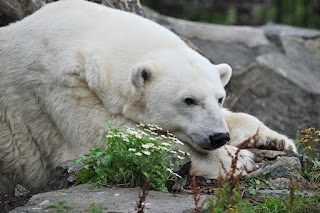
Mercedes was born in the wild in the western Hudson Bay region of Manitoba Canada in late 1980 or 1981. When she naturally separated from her wild mother, she developed the habit of wandering into the local town of Churchill looking for food and needed to be captured and moved a good distance in an effort to curtail her “shopping sprees”. The polar bear policy in Churchill, also known as the polar bear capital of the world, was three strikes and you’re out. Twice she had been caught and moved out of town and a third offence would result in her being shot due to the risks she presented to the townspeople. Luckily a concerned member of the Royal Zoological Society of Scotland with Canadian connections helped save Mercedes from certain death and, following her third offence, she was caught and moved to Edinburgh Zoo on 19 January 1984. Whilst at Edinburgh she reared 2 cubs: Minty, a male, born on 18 November 1988, and Ohoto, a female, born 15 November 1991. Both were sired by her partner Barney, who was born at Whipsnade Zoo, but he died on 19 November 1996. After Barney’s death, Mercedes lived by herself at Edinburgh Zoo; a solitary lifestyle, especially for an adult female polar bear, is normal as they are not overly social creatures.

Walker and Mercedes
Photo credit: Aaron Sneddon
In late 2008/early 2009, the decision was finalised to move her to a new, much larger enclosure at Edinburgh’s sister zoo, the Highland Wildlife Park. Using a radical new enclosure design, we were able to construct a very large area for Mercedes’ retirement at the Park, although there was some concern over how she would react to the wide open space in the Highlands. Mercedes moved into her new, large, natural enclosure at the Highland Wildlife Park on 19 October 2009. Her arrival generated unprecedented media and public interest. When she was released into the new enclosure she quickly adapted to her bigger, softer surroundings and she particularly relished the deep snow and iced-over pond in the winter. Because of the size and natural complexity of our facility, the European breeding programme coordinator for polar bears asked us if we could take the 2 year old male Walker from Rhenen Zoo in Holland. Walker needed to be moved due to the pending birth of cubs from his aunt. Although Walker was at the age where he needed to be separated from his mother, we felt confident that he would be respectful of the much older Mercedes and not present her with a problem; Walker arrived on 5 November 2010. From the time we first mixed the 2 polar bears together, it was clear that Walker wanted to play, but Mercedes was having none of it and rebuffed all of his attempts at contact. Luckily the enclosure is large enough that the bears could keep well apart from each other and we provided Walker with a wide range of suitable polar bear toys and this left Mercedes to carry on with her more sedate routine.
Because Mercedes was at the upper end of the captive polar bear age scale, about 29-30 years old (wild polar bears rarely make it to their mid-20s), we have been routinely monitoring her health and particularly her level of mobility; older bears are very prone to developing quite pronounced arthritis. We thought that she was getting a bit slower, which was to be expected, but the arrival of the boisterous Walker really demonstrated the difference in the bears. We have had Mercedes on a carefully planned course of medication to ease any likely joint problems, and we had seen a bit of an improvement in her condition. She was monitored daily by her keepers and weekly by our vet. More recently we noted a marked and rapid downturn in her behaviour and her demeanour, and she appeared to be aging very rapidly and possibly showing signs of senility. We had been keeping her separate from the male bear so as to avoid any possibility of him causing her to move more than she wanted to. Recently, all of the individuals responsible for her care sadly concluded that our only remaining option was to put her to sleep on age and health grounds.
Simon Girling, RZSS head of veterinary services says of Mercedes’ condition, “
We have been monitoring Mercedes' condition for some time now and have tried a number of different therapies for her advanced arthritis, which we were having some success with. However, even on medication, Mercedes has now taken a significant turn for the worse in terms of her mobility and is also showing signs of mental confusion. This deterioration in her welfare has prompted us to step in and humanely euthanase her.” In addition, Jane Harley, the Highland Wildlife Park’s local veterinary consultant has a similar opinion, “
Mercedes has shown a marked deterioration in her condition over the last week. She has signs of severe pain from arthritic joints that the medication no longer appears to be controlling. She also appears to be showing signs of "old age senility" which is causing her confusion and distress. This has been a difficult decision for everyone who has been involved with Mercedes, but is the right decision for a very special bear.”
She will undergo a very thorough post mortem examination so that we can learn more about her condition and this will help provide more information on how we deal with geriatric bears in the future. One of Mercedes’ most significant contributions to the future welfare of polar and other bear species was in successfully “test-driving” our new enclosure design as it is one that is relatively cheap to construct and this low cost means that much larger bear enclosures can be built in zoological collections which results in better bear welfare. It goes without saying that Mercedes will be greatly missed by those who cared for her and by her many admirers.
Also Read
***
For regular updated Zoo News, Views, Reviews and Vacancies please visit
Zoo News Digest
on

Please Visit
The Zoo Professionals Book Store
if you are looking for a book. This is an Amazon affiliate and you will get a good deal
also
you can subscribe to the largest and longest established zoo related ezine
by clicking
HERE
Money for Free
If you can write, you can earn. Write about what you like or what you know about. Build up a passive income which will earn you money daily. No catch, no charge. Click on the link below and you could start earning today


