Showing posts with label breeding programmes. Show all posts

Thursday, July 23, 2015

Freaks in Zoos


Freaks in Zoos

I don't like zoos exhibiting freaks. They make me ashamed of parts of the industry in which I love and work. Zoos are about conservation breeding and education they are not some 18th Century sideshow where the Bearded Lady and the Dog Faced Man sit alongside the Six Legged Sheep and Three Eyed Goat.

People don't like me using the word 'Freak' so it is worth dealing with that definition first:

Wikipedia - "Freak" continues to be used to describe genetic mutations in plants and animals, i.e. "freaks of nature."

The Free DictionaryAn abnormally formed organism, especially one regarded as a curiosity.

Merriam Webster - a person or animal having a physical oddity and appearing in a circus sideshow

Oxford Dictionary - A person, animal, or plant with an unusual physical abnormality

So my use of the word in connection with White Tigers, White Lions, White Alligators, Two Headed Snakes and Turtles is entirely correct.

There is no question about it...All of such "abnormally formed organisms" can, will and do occur in nature. That is nature. The vast majority of such physically disadvantages creatures are unlikely to survive too long. If they live to old age in the wild then I for one would be both happy and just a bit amazed.

Such freaks also occur in captivity and I have no problem with that if they are naturally occurring. Let them live, let them play a part in education. Their quality of life needs to be seriously assessed however and euthanasia must be an option. Keeping physically disadvantaged animals alive and on show just to get people in through the gate can be both cruel and wrong..

Claims that such creatures will be raising money for 'conservation' should be given serious investigation.....does even one cent actually ever go to conservation?

Where things go really wrong in my world is when 'freaks' are deliberately bred with other freaks or closely related animals to produce yet more freaks. This is clearly the case with White Tigers and Lions and other freak mutations. These animals are conservationally useless. What these Dysfunctional Zoos are doing is very very wrong. All they are concerned about is getting more money in their coffers regardless of whatever argument they put forward to justify their sins.

Then there are the collections which go out of their way to purchase freaks to put on display. Such collections, to me, instantly slot themselves into the Dysfunctional Zoo category. One wonders just what they are going to come up with next? The bearded lady?


Thursday, February 13, 2014

Adopt a Sperm


Can't have tiger sperm of your own? Adopt-a-sperm instead!
The South-East Zoo Alliance for Reproduction & Conservation launches a unique way to help support the repopulation of endangered species.

Every day, all throughout the animal world, millions of sperm are going to waste, swimming their way to fruitless oblivion. This sperm, if properly harvested and shared, could be used to help save the planet's endangered species from extinction.
The South-East Zoo Alliance for Reproduction & Conservation (SEZARC) is on a mission to do just that — and is now asking the public to lend a hand to their sperm collecting efforts.

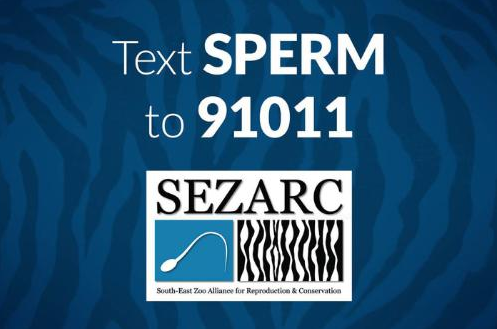
By simply texting SPERM to 91011, texters will receive a link that allows them to donate $10 (or more) to SEZARC's efforts to artificially inseminate endangered species at wildlife conservation centers and zoos around the world.

Before potential adopters start trolling Craigslist for tigers or Somali wild asses in heat, SEZARC Director Dr. Linda Penfold is quick to clarify that people who adopt the exotic sperm will not actually receive frozen animal semen in the mail: "All human donors will be parents in name and spirit only; the sperm we collect is stored and maintained in scientific-appropriate facilities until a prime candidate for impregnation is found."

Adoptive parents may not get the seed, but they won't be left empty handed once they've done the good deed: all donors will receive a link to a Certificate of Adoption that they can print, frame and proudly display.

While the "Adopt-a-Sperm" campaign has an air of irreverence, the organization it supports is actually a serious scientific collective endorsed by leading zoos and conservation groups. SEZARC is currently working on many breeding projects and studies around the globe, including studying the reproductive endocrinology and behavior of giant river otters, stingrays and Malayan tigers in captivity; artificially inseminating jaguars and cheetahs, and collecting and banking sperm from South African elephants, Somali wild asses, cheetahs, gorillas, antelope species, maned wolves and more.

"The Adopt-a-Sperm idea is obviously a bit tongue-in-cheek," says Dr. Penfold. "But the reality is, the financial donations it generates will go a long way to helping a great number of endangered species in need."

"Just like the male animals in our program, we encourage everyone to give, and give often."

To donate, text SPERM to 91011 or visit www.sezarc.org.
The South-East Zoo Alliance for Reproduction & Conservation (SEZARC) is a not-for-profit organization dedicated to saving endangered species through reproductive science. Specializing in pregnancy and fertility checks, assisted reproduction and conservation planning, SEZARC actively collaborates with scientists, veterinarians and animal managers at zoological institutions, governments and universities around the world.
SEZARC partners include Birmingham Zoo, Dallas Zoo, Disney's Animal Kingdom, Jacksonville Zoo & Gardens, North Carolina Zoo, Micanopy Zoological Preserve, White Oak Conservation Center, Turner Enterprises, Inc. and University of North Florida.

Collaborators include Chester Zoo (U.K.), Chestnut Centre Conservation and Wildlife Park (U.K.), Cleveland MetroParks, SeaWorld, New England Aquarium, Georgia Aquarium, Ripley's Aquarium, Los Angeles Zoo, the Institute for Breeding Rare and Endangered African Mammals, Elephant Population Management Program, Smithsonian Conservation Biology Institute and more.


Saturday, August 24, 2013

Zoo Genetics

Zoo Genetics

Why properly managed breeding programmes in Good Zoos is Important


Zoo Genetics Section 1 Tamarins


Zoo Genetics Section 2 Chromosomes
 Zoo Genetics Section 3 Dolphins
Zoo Genetics Section 4 Possums
 Zoo Genetics Section 5 Lions
 Zoo Genetics Section 7 Penquins Zoo Genetics Section 8 Lemurs

Friday, August 23, 2013

Cloning Wild Life: Zoos, Captivity, and the Future of Endangered Animals


Cloning Wild Life: Zoos, Captivity, and the Future of Endangered Animals


“In this brilliant study of cloned wild life, Carrie Friese adds a whole new dimension to the study of reproduction, illustrating vividly and persuasively how social and biological reproduction are inextricably bound together, and why this matters.”—Sarah Franklin, author of Dolly Mixtures: the Remaking of Genealogy

The natural world is marked by an ever-increasing loss of varied habitats, a growing number of species extinctions, and a full range of new kinds of dilemmas posed by global warming. At the same time, humans are also working to actively shape this natural world through contemporary bioscience and biotechnology. In Cloning Wild Life, Carrie Friese posits that cloned endangered animals in zoos sit at the apex of these two trends, as humans seek a scientific solution to environmental crisis. Often fraught with controversy, cloning technologies, Friese argues, significantly affect our conceptualizations of and engagements with wildlife and nature.


By studying animals at different locations, Friese explores the human practices surrounding the cloning of endangered animals. She visits zoos—the San Diego Zoological Park, the Audubon Center in New Orleans, and the Zoological Society of London—to see cloning and related practices in action, as well as attending academic and medical conferences and interviewing scientists, conservationists, and zookeepers involved in cloning. Ultimately, she concludes that the act of recalibrating nature through science is what most disturbs us about cloning animals in captivity, revealing that debates over cloning become, in the end, a site of political struggle between different human groups.  Moreover, Friese explores the implications of the social role that animals at the zoo play in the first place—how they are viewed, consumed, and used by humans for our own needs. A unique study uniting sociology and the study of science and technology, Cloning Wild Life demonstrates just how much bioscience reproduces and changes our ideas about the meaning of life itself.


To learn more or purchase this book please visit


Saturday, April 17, 2010

Magdeburg Zoo director defends tiger killing

Magdeburg Zoo director defends tiger killing


The director of Magdeburg Zoo, Kai Perret has defended the decision to euthanase three generic tiger cubs in May 2008. The decision was based on the fact that generic tigers make no direct contribution to conservation and to keep and maintain such animals in the long term would harm the long term prospects of managed tiger cub species. The cubs were euthanased shortly after they were born.

The prosecution has accused Kai Perret and three of his employees of killing the tigers without reasonable cause in the May 2008.

 Magdeburg Zoo had discovered than their male Siberian Tiger 'Taksan' was not a pure bred Siberian as was believed and therefore any progeny fathered by him would contribute nothing to the Siberian Tiger breeding programme of which the zoo is a participating member. Director Perret was correct in his decision to euthanase as no other reputable participating European zoo would have been prepared to take the cubs.


An animal welfare organisation lodged a complaint against Perret and his staff. If convicted they face fines and possible imprisonment of up to three years.

The real crime here is the the fact that the animal welfare organisation does not have the faintest idea of what a breeding programme is about. They are the ones who should be prosecuted.

It is hoped the the world community of reputable zoos and individuals who understand will give their maximum support to Magdeburg Zoo over this issue.


For regular updated Zoo News, Views, Reviews and Vacancies please visit
Zoo News Digest on

And Learn More About Zoos and Aquariums by visiting