Showing posts with label Taronga Park Zoo. Show all posts

Saturday, August 20, 2016

Zoos ask travelers to photograph wildlife trafficking


Zoos ask travelers to photograph wildlife trafficking


San Diego Zoo Global has joined with zoos around the world in support of an international campaign to stop the massive and cruel illegal trade in wildlife—the fourth largest illegal trade in the world, after drugs, weapons and human trafficking. The global “Lend Your Eyes to the Wild” campaign encourages individuals to be the eyes and ears in the fight against wildlife trafficking.

In the past decade, wildlife trafficking has escalated into an international crisis, and it has become a multibillion-dollar-per-year global criminal activity. Wildlife trafficking includes the illegal activities of obtaining and selling live animals and plants, or parts of animals and plants, such as meat, ivory, horns, bones, teeth, fur, skin, wood, leaves, feathers and shells. Illegal wildlife and related products are sold to people as exotic pets; exotic food; items for adornment and display; items to show off wealth or status; or as remedies for ailments that have no proven effectiveness.

“San Diego Zoo Global is in the business of ending extinction; combating illegal wildlife trafficking is an important part of meeting that goal,” stated Randy Rieches, curator of mammals, San Diego Zoo Safari Park. “Tragically, animals and plant species are being killed or taken from the wild in epic proportions, decimating their populations and affecting ecosystems.”

The “Lend Your Eyes to the Wild” campaign encourages travelers to Southeast Asia to report illegal wildlife trade activities they may observe in markets, in shops or at airports, through the use of Wildlife Witness, a free app that can be downloaded on iPhones and Android devices. The app—developed by Taronga Zoo in Australia in conjunction with TRAFFIC, the wildlife trade monitoring network—allows individuals to take a photo, “pin” the exact location of an incident and send these important details to TRAFFIC. The information received is then routed to the proper legal authorities capable of arresting and prosecuting those engaged in the trade. The app user who identifies the illegal wildlife trafficking situation remains anonymous throughout the process.


“Our partnership with TRAFFIC and the Taronga Zoo in supporting this mobile app is another way to raise awareness for the plight of endangered wildlife,” said Rieches. “We can’t do this alone; we need everyone’s help.”


The demand for illegal wildlife products is prevalent in several countries. While China and Vietnam are two of the primary destinations for most trafficked goods, the U.S. is the second leading recipient of illegal ivory, with California and New York key wildlife trafficking ports of entry and consumer markets.

At the state level, San Diego Zoo Global supported California becoming the third U.S. state to ban the sale of ivory with the passage of Assembly Bill 96, which was broadened to outlaw the sale of rhino horn, as well. Nationally, San Diego Zoo Global has formed a Wildlife Trafficking Task Force (WTTF), in collaboration with the U.S. Fish and Wildlife Service and other law enforcement agencies and conservation organizations to help stop wildlife trafficking. San Diego Zoo Global is also called upon to take care of plants and animals that are confiscated at ports of entry like the U.S.-Mexico border and Los Angeles International Airport.
Worldwide, San Diego Zoo Global is leading and inspiring wildlife protection, working on more than 140 projects in nearly 80 countries.

At the current rate of poaching, animals including elephants, rhinos, tigers, pangolins and some species of turtles are expected to disappear from the wild within 10 to 30 years. Tens of thousands of elephants have been slaughtered for their ivory tusks in the past five years by poachers in Africa—including 85,000 just in Tanzania. In 2015, more than 1,200 rhinos were killed for their horns in South Africa alone; the majority of those were white rhinos.

Since the Wildlife Witness app launched in May, incidents referred to law enforcement agencies have resulted in more than 1,200 important pieces of intelligence and helped authorities take action against more than 500 people involved in global wildlife trade. For more information, and to download the Wildlife Witness app, visit wildlifewitness.net.


Bringing species back from the brink of extinction is the goal of San Diego Zoo Global. As a leader in conservation, the work of San Diego Zoo Global includes on-site wildlife conservation efforts (representing both plants and animals) at the San Diego Zoo, San Diego Zoo Safari Park, and San Diego Zoo Institute for Conservation Research, as well as international field programs on six continents. The work of these entities is inspiring children through the San Diego Zoo Kids network, reaching out through the internet and in children’s hospitals nationwide. The work of San Diego Zoo Global is made possible by the San Diego Zoo Global Wildlife Conservancy and is supported in part by the Foundation of San Diego Zoo Global.
(From Press Release)


Peter Dickinson
Independent International Zoo Consultant
      

Saturday, September 4, 2010

Boy Bitten By Sea Lion During Zoo Show

Boy Bitten By Sea Lion During Zoo Show


The statement a from the Taronga Zoo about this incident immediately drew my attention.

'Taronga said the eight-year-old animal involved had a long history of participating in encounters with audience members and had never displayed aggressive behaviour before.'

I am sure they are right and that is the case. Apparently the boy unknowingly spooked the animal. Animals remain wild animals and we never truly know them. Taronga is a responsible collection and I am sure that they are extremely upset that this incident occurred. There will be a thorough investigation with a view to minimising the risk in the future.

Sea Lion encounter programmes and sessions take place the world over. There is even the opportunity to swim with Sea Lions in some collections. Over the years I have seen some nasty Sealion bites and all of them given unexpectedly by placid animals. It is worth bearing in mind that close contact with wild animals is an accident waiting to happen.

This 'encounter risk' is elevated vastly by those who allow close contact with any of the large carnivores such as Tigers, Lions and Bears. We even had a wolf attack in a zoo recently. The idea of letting people swim with an expressionless alligator is crazy and yet some collections allow it.

I hope that all encounters in responsible zoos today are without incident because they do offer visitors an incredible and unforgettable experience. An experience which may win them over to support that species for the rest of their lives.

Read the full story of Australian boy mauled by sea lion at zoo


***
For Books on Zoo Management and more please visit
***
For regular updated Zoo News, Views, Reviews and Vacancies please visit
 Zoo News Digest on
Learn More About Zoos and Aquariums by visiting
The Zoo Hubs
and subscribe to the largest and longest established zoo related ezine
by clicking
HERE


To advertise on Zoo News Digest please click

Wednesday, March 10, 2010

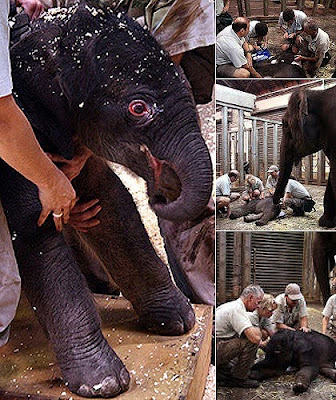
The Elephant Calf Was Born Alive!! Congratulations and Good Luck

"Dead" baby elephant calf born alive in Sydney zoo


Photo by: Taronga/Bobby-Jo Vial


An elephant gave birth to a calf at Sydney's main zoo on Wednesday, surprising vets and keepers who two days earlier declared the baby had died in the womb.
The Asian elephant mother delivered the male baby in the early hours of Wednesday in what Taronga Park Zoo officials said was "unbelievable good fortune".

"Dedicated keepers reported the amazing news early this morning that the calf had been born and was showing signs of life," said zoo director Cameron Kerr.

On Monday, Kerr said despite an expert team of vets who had prepared for every eventuality, the calf had not survived after six days of labor, and ultrasounds found there was no chance of a successful birth.

Officials said they now believe the calf was in a coma throughout the labor. They said the calf had since taken its first steps, but it was too early to know if it would survive.

"When the keepers learned the calf had survived this morning, the looks of disbelief on our faces were quite a picture. We couldn't believe....
(Reporting by James Grubel, editing by Miral Fahmy)

http://uk.reuters.com/article/idUKTRE6290VR20100310

 'Back from the dead' baby elephant takes first steps


A baby elephant that was presumed to have died in the womb has taken its first steps after a 'miracle' birth, in an encouraging sign that it might survive its crucial first days.
 
The male Asian Elephant calf, which was born at 3.27 am at Sydney's Taronga Zoo, was showing some early encouraging signs including attempting to suckle from its mother, Porntip and meeting other herdmates, a statement from the zoo said.


Dr Larry Vogelnest, Taronga's senior veterinarian, said: "The calf has already had some contact with the other elephants in the herd, touching trunks with the older females and also the zoo's first calf, Luk Chai, an eight-month old male.

"The others are very excited and curious, reaching out to him with their trunks whenever he gets close."


"Porntip is already showing signs of being an excellent mother, trying to help him suckle although he hasn't quite managed to suckle yet. She's in good health and has been getting to know her calf, gently touching the young animal with her trunk."

The calf's live birth was hailed as a miracle after several in utero checks showed that it had no vital signs. Dr Thomas Hildebrandt, an elephant reproduction expert who had flown to Sydney from Berlin to attend the birth, had said the calf was in a position - upside down and head first - that would make survival almost impossible.

But zoo staff's sorrow turned to joy when the calf was born weak but breathing.

The Birth Team has since reported that in between sleeps, the baby elephant has been taking its first steps and moving around the birthing pen in the Elephant Barn.

Dr Vogelnest said: "We've been able to give him several litres of colostrum, the important first milk for newborns and we think he weighs between 90 and 100 kg."


"Our initial impressions are that he is stockier than Luk Chai but maybe not as tall."

Cameron Kerr, the zoo's director, said: "The Zoo's elephant team are focusing entirely on supporting the calf through the critical first 24 hours and we're asking for patience and understanding while they endeavour to give the youngster its best chance of survival."

"Advice from world elephant reproduction expert, Dr Thomas Hildebrandt of the Berlin Institute for Zoo and Wildlife Health is that such an outcome after a protracted labour has never been seen before. He said the birth will completely re-write the elephant birth text books."

Dr Vogelnest said: "The early indications are that the calf survived the protracted labour in a coma. That unconscious state would explain the complete absence of any vital signs during all the checks and examinations we conducted during the labour and led us to believe the calf had not survived."

Gary Miller, the elephant manager, said: "When the keepers learned the calf had survived this morning, the looks of disbelief on our faces were quite a picture. We couldn't believe that this could be true."

The other elephants in the herd, Pak Boon, Tang Mo and Thong Dee, as well as the older calf, Luk Chai, have been gently caressing the newborn with their trunks, touching trunk tips and very interested in the new calf.

Dr Vogelnest said the Birth Team was taking

Full Story