Showing posts with label African Penguin. Show all posts

Thursday, January 19, 2017

BSc (Hons) Project - Can we afford to lose African penguins?


BSc (Hons) Project Institute for Coastal & Marine Research (ICMR) Nelson Mandela Metropolitan University Port Elizabeth 

Can we afford to lose African penguins? 

Duration: 2017 

Supervisor: Dr Lorien Pichegru, Institute for Coastal and Marine Research

Co-supervisors: Prof. Mandy Lombard, Institute for Coastal and Marine Research
Peter Myles, Tournet Africa. 

Bursary attached to the project: R40 000. 

Background 

Penguins are highly iconic species much loved by the general public. They are also among the most threatened seabird species (Croxall et al. 2012). 
African penguin numbers have decreased by 70% since 2004 in South Africa (Crawford et al. 2011), and major conservation efforts have been undertaken to reverse this trend, such as the removal of predators on colonies or the implementation of artificial burrows for shelter against extreme weather events (Pichegru 2013). 
One of the main factors behind the decline in numbers is a lack of prey, owing to a recent shift over the past decades in the distribution and abundance of their preferred prey, sardines and anchovies (Crawford et al. 2015). This shift has resulted in competition with the purse-seine fishery for the same resource pool of small pelagic fish, especially around the penguin breeding colonies, to which adults must return in order to feed their offspring regularly (Pichegru et al. 2012). 
The purse-seine fishing industry is the largest fishery in South Africa in terms of landings (>600 000 t annually, Department of Agriculture, Forestry and Fisheries (DAFF), unpubl. data), contributing significantly to the Gross Domestic Product (GDP), and conservation management decisions are traded off against human livelihoods and jobs. 
The African penguin, however, is the only penguin in Africa and a major tourist attraction in South Africa (Lewis et al. 2012). Unfortunately, there is limited information on direct income generated from penguin-related tourism in South Africa and its contribution to the GDP, particularly in the Eastern Cape. 
This project will estimate the direct and indirect contribution of African penguins to the national and provincial economy in terms of direct revenues and job creation in order to inform trade-offs in conservation-fishery management decisions. 

References 

Crawford, R.J.M., Altwegg, R., Barham, B.J., Barham, P.J., Durant, J.M., Dyer, B.M., Makhado, A.B., Pichegru, L., Ryan, P.G., Underhill, L.G., Upfold, L., Visagie, J., Waller, L.J., Whittington, P.A., 2011. Collapse of South Africa’s penguins in the early 21st century: a consideration of food availability. Afr. J. Mar. Sci. 33, 139-156.

Crawford, R.J.M., Makhado, A.B., Whittington, P.A., Randall, R.M., Oosthuizen, W.H., Waller, L.J. (2015) A changing distribution of seabirds in Suth Africa – the possible impact of climate and its consequences. Front. Ecol. Evol. (3), 1-10. 

Croxall, J.P., Butchart, S.H.M., Lascelles, B., Stattersfield, A.J., Sullivan, B., Symes A., Taylor, P. (2012). Seabird conservation status, threats and priority actions: a global assessment. Bird Conserv. Inter. 22, 1-34. 

Lewis, S.E.F., Turpie, J.K., Ryan, P.G. 2012. Are African penguins worth saving? The ecotourism value of the Boulders Beach colony. Afr J Mar Sci 34:497–504. 

Pichegru, L. 2013. Increasing breeding success of an Endangered penguin: artificial nests or culling predatory gulls? Bird Conserv. Inter. 23, 296-308

Pichegru, L., Ryan, P.G., van Eeden, R., Reid, T., Grémillet, D., Wanless, R. 2012. Industrial fishing, no-take zones and endangered penguins. Biol. Conserv. 156: 117-125


Peter Dickinson
Independent International Zoo Consultant
      

Tuesday, December 7, 2010

Penguin chicks rescued to help save a species

Photo Credit: Cheryl-Samantha Owen


More than 450 endangered African penguin chicks have been saved from starvation in South Africa in a project led by the Bristol Conservation and Science Foundation and Bristol Zoo to save this increasingly threatened species.

The rescued chicks, aged between seven and nine-weeks-old, have been taken to the SANCCOB (Southern African Foundation for the Conservation of Coastal Birds) headquarters in Cape Town after being collected from land and island-based penguin colonies near Cape Town.

The 459 chicks will now be hand-reared for around six weeks before returning back to their colonies in the wild. This is the largest number of chicks SANCCOB has cared for at any one time since 2007 when 481 abandoned chicks were treated.

The effort is part of a ‘chick bolstering project’, named Project Penguin, being run by the Bristol Conservation and Science Foundation and Bristol Zoo Gardens in partnership with SANCCOB, the International Fund for Animal Welfare (IFAW), Robben Island Museum, the University of Cape Town’s Animal Demography Unit, Cape Nature and Oceans and Coasts (Department of Environmental Affairs, South African government).

Penguin chicks that hatch late in the breeding season are frequently abandoned by their parents when the weather grows warmer and as food supplies diminish. The problem is exacerbated by the fact that remaining adult penguins begin their annual moult at this time of the year. During moulting the penguins shed their old feathers and grow new ones, leaving them not waterproof and therefore unable to swim, catch fish and feed their chicks.

Dr Christoph Schwitzer, Head of Research at the Bristol Conservation and Science Foundation, based at Bristol Zoo, said: “This is a huge effort to conserve an endangered species and every chick is vitally important. Unless conservation organisations intervene, these chicks would starve to death and there is a substantial risk that this species could eventually become extinct.”

Venessa Strauss, Chief Executive Officer of SANCCOB, added: “Our research shows that hand-rearing African penguins has a significantly positive effect on conserving the wild populations, with hand-reared and released chicks showing higher survivorship to breeding age and higher productivity than birds that fledge naturally in the wild.”

Scientists have seen numbers of African penguins decline more than 50 percent in just three generations, leading to the species' re-classification from Vulnerable to Endangered on the IUCN Red List of Threatened Species earlier this year.

Dr Schwitzer added: "When we release the penguins in around six weeks’ time, they will be fitted with flipper bands. As part of the project, some chicks will also be fitted with satellite transmitters so we can track their movements. This will help us investigate which factors determine the penguins’ breeding site fidelity and how we can help them establish new breeding colonies at sites closer to the fish stocks.”

For more information about Bristol Zoo Gardens’ African penguins, or for adoption details, visit the website http://www.bristolzoo.org/.uk or phone 0117 974 7300.

See More on this project by clicking HERE


***
For Books on Zoo Management and more please visit
***
For regular updated Zoo News, Views, Reviews and Vacancies please visit
 Zoo News Digest on
Learn More About Zoos and Aquariums by visiting
and subscribe to the largest and longest established zoo related ezine
by clicking

'No Mirrors Involved'
Snow Leopards
Photo supplied by Peter Litherland of the


To advertise on Zoo News Digest please click

Thursday, April 15, 2010

AFRICAN PENGUIN CHICKS FIRST SWIM AT MYSTIC AQUARIUM

AFRICAN PENGUIN CHICKS AT MYSTIC AQUARIUM
TAKE THEIR FIRST SWIM TODAY

Event marked chicks’ introduction to the public and first time on exhibit

MYSTIC, Conn. (April 15, 2010) – Mystic Aquarium’s newest African penguin chicks showed off their newfound swimming skills this morning. For the first time, the two chicks took the plunge into the Roger Tory Peterson Penguin Exhibit and were introduced to the public.

The chicks – Blue-Purple, 78 days old today, and Blue-Black, 77 days old – are fully weaned and ready to begin their acclimation to the exhibit and aquarium’s colony of penguins. Many watched the chicks, born on January 27 and 28, grow up over the past two months on the live Web cam at http://www.mysticaquarium.org/

“Learning to swim is the first step,” said Laurie Macha, supervisor of penguins and pinnipeds at Mystic Aquarium. “Penguin chicks tend to float very well, but they must learn to dive and navigate using their wings and feet. Chicks learn quickly, however, and will usually acquire these skills within a day.”

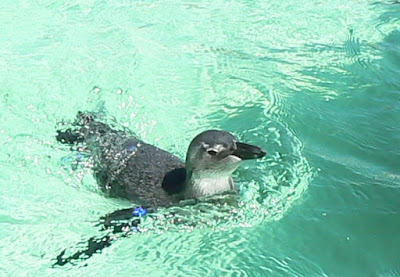
The chicks were hesitant to go into the water at first, but after being carefully guided in by penguin trainers, they took off, swimming around the exhibit and eventually finding their way back to the exhibit’s dry areas, only to jump back into the water after drying off.

The chicks were also introduced to a few of the colony’s more docile birds and will slowly be introduced to the aquarium’s 27 penguins to establish their places within the colony. By the end of April, the chicks will be on exhibit a few hours each day.


Today also marks the one-year anniversary of African penguin Blue-Blue’s first swim. Blue-Blue was the first chick to appear on a live Web cam on the aquarium’s Web site and is now about to molt for the first time. Black and white feathers will soon replace his dark gray plumage.

About Sea Research Foundation, Inc.
Mystic Aquarium, Institute for Exploration and Immersion Learning are divisions of Sea Research Foundation, Inc., a non-profit 501(c)3 organization. The mission of Sea Research is to inspire people to care for and protect our ocean planet through education, research and exploration.

Contact: Becky Giantonio

(860) 572-5955, ext. 338
cell: (860) 514-9514
bgiantonio@mysticaquarium.org