Showing posts with label Japan. Show all posts

Saturday, March 19, 2011

Latest News From The Japanese Zoos and Aquariums


March 18, 2011


Dear Sir and Madam,

On behalf of JAZA and its membership of 156 members, I announce you that 14 of our member institutions experienced the damages due to the massive earthquake and resulting tsunami on March 11, 2011. The worst damage occurred at the institutions that are located on the coast of Tohoku area, the region that has become the center of attention on most international news programs due to the nuclear crisis. The Aquamarine Fukushima and Marinepia Matsushima Aquarium experienced critical damage which includes structural, electrical, and environmental damages.

Due to the inability to distribute resources including feed, water, electricity, and other basic necessities, the zoo and aquariums have suffered greatly in their ability to acquire the proper commodities for the animals. JAZA, in cooperation with our member institutions, has already been cooperating in supplying as many resources as possible to those members affected.

JAZA has received urgent transfer permission under the Act for Conservation of Endangered Species of Wild Flauna and Flora of all live species including the Walrus (Odobenus rosmarus), Steller Sea Lion (Eumetopias jubatus), Eurasian otter (Lutra lutra), Common Murre (Uria aalge), and the Tufted Puffin (Fratercula cirrhata) from the Ministry of Environment. JAZA is proud to announce the transfers from Aquamarine Fukushima were completed on March 17th, 2011

JAZA also completed the urgent transfer of feed to our institutions in the affected areas which included the Yagiyama Zoological Park in Sendai, the Morioka Zoological Park in Iwate, and the Akita Omoriyama Zoo in Akita.

The details of each affected institution (as of March 14, 2011) are described below:

1. Facilities Damaged (as of March 14, 2011)

Zoos:

A) Akita Omoriyama Zoo (Akita, Akita)

There was no damage on enclosures. They have the difficulty for its lifeline including blackout. It is difficult for them to get the feed.


B) Morioka Zoological Park (Morioka, Iwate)

There was no damage on enclosures and animals. The electricity is cut off. Also they are without water. It is difficult to them to get the fuel and feed.


C) Yagiyama Zoological Park (Sendai, Miyagi)

There is no damage on animals. They need to fix a part of buildings and parking lot. They have the difficulty for its lifeline. It is difficult for them to get the feed.


D) Nasu Animal Kingdom (Nasu, Tochigi)

They got the damage on its hot spring facility. They need to close temporally, but there is no damage at zoo.


E) Kiryugaoka Zoo (Kiryu, Gunma)

They got the cracks and damange on the street inside of zoo. The glasses of office building were broken.


F) Hitachi City Kamine Zoo (Hitachi, Ibaraki)

They are under blackout without water and temporally closed. There was no damage on its facilities and animals. They don’t have enough stock of feed materials.


G) Tobu Zoological Park (Minamisaitama, Saitama)

There was no damage on animal facilities. They got the damage on the play equipments.


Note: The institutions A-C color don’t have the way to get the feed for animals, they requested JAZA to ensure it for them. We continue to get the updates about the damage they have incurred.


Aquariums:

H) Chitose Salmon Museum (Chitose, Hokkaido)

They got damage on a part of their facilities. A part of fishes were died.


I) Aomori Prefectural Asamushi Aquarium (Aomori, Aomori)

They temporally got blackout.


J) Oga Aquarium GAO (Ojika, Akita)

They are under blackout.


K) Marinepia Matsushima Aquarium (Miyagi, Miyagi)

The first floor of their building was flooded by tsunami and the machine room and electric room were submerged completely. This caused huge damage. All of the staff and animals are fine. They have in-house power generation.


L) Aquamarine Fukushima (Iwaki, Fukushima)

There were no human casualties included the staff, volunteers, visitors who were there when tsunami coming, vendors. The tsunami made their facility flooded in first floor, and underground installation and electric system were damaged. There was the massive damage on animals. The alive animals were already transferred to other institutions included Ueno zoo (Tokyo) and Kamogawa Sea World (Kamogawa, Chiba). All of the aquarium owned vehicles cannot be used by the damage of tsunami.


M) Ibaraki Prefectural Oarai Aquarium (Higashiibaraki, Ibaraki)

They are under blackout, but they have in-house power generation. Four parts of plumbing system are broken. A part of parking lot is completely flooded. All of the staff are fine.


N) Epson Aqua Stadium (Tokyo)

There were no human casualties. A part of artificial rocks in the tube tank was broken.


Note: The institutions K-M got the damage by tsunami. We continue to get the updates about the damage they have incurred.


2. Support Received (as of March 18, 2011)

A) The transfer of feed and materials

We brought the feed and materials to the institutions as follows: Yagiyama Zoological Park, Akita Omoriyama Zoo, Morioka Zoological Park.


Itinerary: Leave Tokyo on March 17th, Reach to Yagiyama Zoological Park on 18th, then move to Akita Omoriyama Zoo and Morioka Zoological Park (planning to be there on 19th)


Transport materials: The feed (especially solid feed) and materials that the institutions required


B) Giving animals immediate protection

The marine mammals and birds in Aquamarine Fukushima were transferred to Kamogawa Sea World, Ueno Zoo, Kasai Sea Life Park, Enoshima Aquarium, Izu Mito Sea Paradise.


C) Establishment of the donation system for the affected area and affected institutions


D) Enhancement of information sharing inside and outside of Japan.

We update the information on our website (www.jazga.or.jp), also opened our official Facebook account: www.facebook.com/jaza.jp


3. Ongoing Support and Future Plans


A) Comprehending the details of damage


B) Planning and implementation of the transfer of the required feed and materials continuously


C) Planning of the appropriate physical support for the details of damage, and the urgent protection of animals


We appreciate all of your support to us. We will keep doing our best.

Thank you very much.

Sincerely yours,

Shigeyuki Yamamoto

Chair

Please see more HERE


***

For regular updated Zoo News, Views, Reviews and Vacancies please visit
 Zoo News Digest on
Learn More About Zoos and Aquariums by visiting
and subscribe to the largest and longest established zoo related ezine
by clicking

***


For Books on Zoo Management and more please visit

Thursday, March 17, 2011

WAZA organizes the “Donate for Japan” emergency assistance operation


Zoos and aquariums affected by earthquake and tsunami in Japan
WAZA organizes the “Donate for Japan” emergency assistance operation

Gland, Switzerland (March 15th 2011): After the earthquake and tsunami that has affected the North of Japan on March 11th, WAZA is joining forces with its Japanese regional association (JAZA) and its member institutions to help the zoos and aquariums in the North of Japan.

“After the horrible earthquake and tsunami in Japan, WAZA is trying to provide financial support for emergency assistance. The most affected zoos and aquariums urgently need help in order to protect staff and save animals”, says Gerald Dick, Executive Director of WAZA - the World Association of Zoos and Aquariums.

Huge damages happened in the northern part of Honshu island. Some affected zoos and aquariums are suffering from shortage of gas, fuel for heater, food and drinking water for both humans and animals.

- Some aquariums in Tohoku area (north part of Honshu Island) have been heavily affected by the earthquake.

- Sendai Marinpia Matsushima aquarium was completely-flooded but there was miraculously no human damage.

- Sendai Yagiyama Zoo estimates a shortage of feeding stuff. The power is out in Sendai city. JAZA is considering concrete measures to send feeding stuff to Sendai Yagiyama Zoo.

- The power is also out at Akita Omoriyama zoo, Morioka Zoo, Asamushi aquarium and Hitachi Kamine Zoo.

- Fukushima aquarium will move their sea mammals and birds to Kamogawa Sea World.

“It is most important for us to secure the adequate means of transport. And we have started a drive to collect donations from the public.” says Kazutoshi Takami, Zoo Veterinarian at Osaka Municipal Tennoji Zoological Gardens.

WAZA is now organizing the cooperation and support for the disaster-affected institutions by collecting donations through its website. Click on the “Donate for Japan” button on the WAZA homepage (http://www.waza.org/) and help us support JAZA.


***

For regular updated Zoo News, Views, Reviews and Vacancies please visit
 Zoo News Digest on
Learn More About Zoos and Aquariums by visiting
and subscribe to the largest and longest established zoo related ezine
by clicking

***


For Books on Zoo Management and more please visit

Thursday, January 21, 2010

Orangutan Makes Peace

Bornean orangutan acts as 'peacemaker' in Japan zoo

A captive Bornean orangutan has been seen acting as a peacemaker, breaking up fights between other warring apes.


It is the first time that an orangutan has been seen behaving in this way, say scientists who published details in the journal Primates.


Peacemakers likely intervene in squabbles to ensure they do not spiral out of control.


That in turn stops violence affecting other apes in the group and helps the animals live harmoniously together.


Wild orangutans usually prefer to lead relatively solitary lives.

"Orangutans spend most of their time alone in the wild," says Dr Tomoyuki Tajima of Kyoto University in Japan, who recorded the behaviour along with colleague Mr Hidetoshi Kurotori, a keeper at the Tama Zoological Park in Tokyo.


"However, they sometimes come and travel together, so researchers regard them as semi-solitary."


Yet in captivity, orangutans socially interact far more often, sometimes becoming aggressive toward one other.


So Tajima is studying how the apes cope with this novel situation.


He was surprised by what he found.


"Orangutans can actively preserve peace in a captive group," he told BBC News.


That conclusion stems from observing five orangutans, comprising two adults, two juveniles and an infant, housed at the Tama Zoological Park.


During this time, one of the juveniles, a six-year-old female named Kiki, was introduced to the group.


Over 13 days of observations, another much older female called Chappy, thought to be 34 years old, became repeatedly aggressive toward Kiki, either chasing or physically attacking her on 28 separate occasions.


During 19 of these interactions, another

Read Full Article

Sunday, January 3, 2010

Zoo Keepers go on 'Marriage' hunt

Dwindling zoo populations force keepers to stage animal 'marriage' hunt

While "konkatsu," or marriage hunting, emerged as a trendy term in 2009, some zoos in Japan engaged in their own version of "konkatsu" -- trying to track down mates for popular animals to produce offspring.


                                           Photo By: http://www.flickr.com/photos/macinate/


On the evening of Nov. 14, Momoko, a western lowland gorilla at Tokyo's Ueno Zoo, gave birth to a female infant roughly one hour, 50 minutes after going into labor. Zoo officials announced the birth of the gorilla, named Komomo, on Dec. 24. It was the first time in six years for a gorilla to be born at a zoo in Japan.


Altogether there are just 24 gorillas in Japan's zoos -- less than half the peak number of 49 in 1990 -- and producing offspring has become a pressing issue. But breeding has been slowed by aging of the primates. The optimal breeding age for gorillas is in their teens, but of the 11 female gorillas in Japan, six are aged 30 or older and three are in their 20s. Just two female gorillas are in their teens.


International trading of gorillas and other rare animals is restricted under the Washington Convention on International Trade in Endangered Species of Wild Fauna and Flora.


"This is not an age in which you can simply buy animals with a wad of notes," says Kenichi Kitamura, a managing director at the Japanese Association of Zoos and Aquariums. The remaining option is "breeding loans," in which the animals are loaned to other zoos.


Momoko came to Ueno Zoo from Chiba Zoological Park at the end of 2008. It was the second time that Ueno had borrowed Momoko. She was also brought to the zoo in 1999 and was returned after giving birth. This time, the gorilla that fathered the infant was borrowed from Australia.


"In 10 years there's a chance that the number of gorillas will be less than 10," said Motoyasu Ida, an education official at Ueno Zoo. "If we don't cooperate, we won't be able to overcome the crisis."


Breeding problems also temporarily put the pinch on Kagoshima City Hirakawa Zoological Park. When its only male koala of breeding age died, it loaned two female koalas to Kobe Oji Zoo and one gave birth, but in a disappointing turn for the zoo, the joey died. This month, however, zoo officials were able to exchange a female koala with a male from Higashiyama Zoo in Nagoya.


Demand has also been high for polar bears. Two zoos have put their hands up for Tsuyoshi, a 6-year-old female bear at Hokkaido's Kushiro City Zoo. At the time of the bear's birth at Sapporo Maruyama Zoo, the zoo mistakenly identified it as a male, and gave it the male name Tsuyoshi, but when it was handed over to the Kushiro zoo for breeding, it emerged that the bear was actually a female. In no time, the heads of Oga Aquarium GAO in Akita Prefecture and Osaka's Tennoji Zoo visited Kushiro with requests to borrow the bear. In the end it was decided to lend Tsuyoshi or another female bear to Akita.


In some cases, deals are made with zoos overseas. In order to diversify the lineage of its cubs, Maruyama Zoo plans to swap a 1-year-old polar bear cub with a zoo overseas.


Hamamatsu Zoo, meanwhile, with waiting for "brides" for its golden lion tamarins. The zoo is the only one in Japan that keeps the animals. It has asked a zoo in the United States for assistance, but Japan's law on the prevention of infectious diseases restricts the places from which monkeys can be imported.


"We have four between the age of 6 and 9 who are looking for mates, and the appropriate age is 4 to 9," says one zoo official.


Journalist Mieko Kenjo, a director of the Tokyo Zoological Park Society, says the loaning of animals may provide

Full Article: http://mdn.mainichi.jp/mdnnews/news/20100102p2a00m0na014000c.html

Tuesday, December 29, 2009

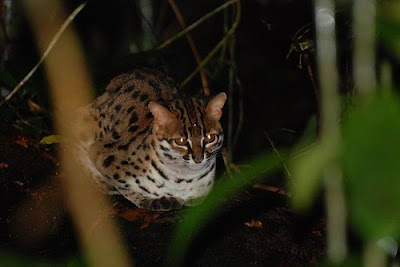
Tsushima Leopard Cat sighted on Shimojima Island

Leopard cat found for 1st time in decades on Tsushima's lower island

A rare leopard cat has been found for the first time on the lower island of Tsushima, in Nagasaki Prefecture, directly confirming their existence there for the first time in more than two decades, conservation officers said Tuesday.


                                                      Bornean Leopard Cat

                                        Photo By: http://www.flickr.com/photos/paulmannix/

The highly protected Tsushima leopard cat, one of two species of wildcats found in Japan, was until recently feared to have completely disappeared from Tsushima's lower island, though as many as 150 are thought to still survive on its upper island.


Officers of the Tsushima Wildlife Conservation Center said the 1,130- gram juvenile, a male thought to have been born only last spring, was found in a weakened state Monday on the property of a company in Izuhara town by an employee who notified authorities.


Officials of the Tsushima Wildlife Conservation Center, established by the Environment Ministry to study the Tsushima leopard cat and assist in recovery of the critically endangered species, were summoned to the scene.


They said the rescued feline, apparently suffering from malnutrition, is currently being nursed back to health at the center.


Leopard cats leave their mother's home range 6 or 7 months after birth, at which time they must struggle to survive on their own.


The Tsushima leopard cat, which is about the same size as a domestic cat but can be distinguished by a white spot on the back of each ear, is thought to have arrived on Tsushima from the Asian continent about 100,000 years ago.


The 696-square-kilometer mountainous territory of some 40,000 people lies in the Korea Strait, only 49.5 kilometers off the Korean Peninsula and 138 km away from Kyushu Island. It separated into two main islands by artificial waterways.


Kamijima, Tsushima's larger and less populated upper island, is home to an estimated 80-110 of the small wildcats, down from an estimated 250-300 in the 1960s, conservation officers said.


But on Shimojima, the lower island, the last confirmed wildcat sighting was in March 2007 when an automatic camera took a photograph of one, confirming their existence there for the first time since 1984 when one was found dead along a road, they said.


Wildlife officer Shinsuke Mizusaki said the leopard cat's numbers have been declining throughout Tsushima mainly due to habitat loss and road kill. Since 1991, 42 of the wildcats have been killed on Kamijima roads, including one earlier this month.


To reverse the decline of the Tsushima leopard cat, which was designated by the Japanese government as a Natural Monument in 1971, it was declared a National Endangered Species in 1994 and a government-funded project was established to protect it.


The project involves field research, habitat restoration, captive breeding and public education about threats to the wildcats which also include diseases carried by domestic cats, illegal snare trapping and feral dogs.


In recent years, the Japanese government has been studying the feasibility of reintroducing wildcats to Shimojima.


The Tsushima leopard cat, which goes by the scientific name Prionailurus bengalensis euptilura, is regarded as an isolated subspecies of the leopard cat, found across Eurasia.


Japan's other wildcat species is the Iriomote cat, or ........

>>>READ FULL ARTICLE>>>


Visit the Tsushima Wildlife Conservation Centre for photos and further information

Sunday, August 9, 2009

Dolphin hunt film sparks dilemma for tourists - Please comment

Dolphin hunt film sparks dilemma for tourists - Please read and comment
‘The Cove’ puts amusement park visitors in bind, park owners on defensive


By Brian Alexander
msnbc.com contributor
updated 9:57 a.m. ET Aug. 6, 2009

The affecting cloak-and-dagger documentary “The Cove,” which documents a brutal dolphin hunt off the Japanese town of Taiji, is putting would-be amusement park visitors in an ethical bind and park owners on the defensive.

The film’s protagonist, Ric O’Barry, who trained the animals that played TV’s Flipper before he had a change of heart, indicts businesses like Sea World as being either overtly or tacitly complicit in the cruelty. “The captivity industry keeps the slaughter going,” O’Barry charges in movie. If he has his way, the gruesome images of bloody dolphins will keep you from buying a ticket to a marine park, or stepping into a pool of one of those “dolphin encounters” at a tropical resort.


Park owners, on the other hand, are crying foul, insisting they have nothing to do with dolphin slaughter and that buying a ticket helps support valuable education and environmental work.

Sea World, part of Busch Entertainment, a division of Anheuser-Busch, which itself is owned by the Belgian beer giant InBev, rejects O’Barry’s criticism, pointing out that it condemns the Taiji dolphin hunt.

“Ric O’Barry has been opposed to dolphin captivity since ‘Flipper,’ ” said Fred Jacobs, the vice president of communications for Busch Entertainment. “He has made a tidy living with that and to take Taiji and somehow lay blame for that tragedy at the feet of Sea World is an outrage ... We hope people will see this as really an outrageous overreach on his part.”

Long notorious for its brutality, the Taiji slaughter is a so-called “drive hunt,” during which fishermen in a string of boats use clanging sounds to herd dolphins into small coves. Once penned, some dolphins are picked out by dolphin trainers and animal brokers for purchase and transport to amusement parks and resorts. The rest are killed with spears, knives and clubs in an orgy of cruelty. As the film graphically shows, the sea water churns into a bloody froth. The cries of the dolphins are pathetic.

But is it really possible that American tourists buying tickets to Sea World are somehow supporting this hunt and others like it? To understand the answer, it helps to know how amusement parks obtain their animals.

Born in captivity
In this country, the Marine Mammal Protection Act of 1972 makes it illegal to take a marine mammal out of the wild without a permit, and illegal to import any marine mammal that has been captured inhumanely. In fact, with public sentiment running strongly against capturing wild animals for shows, said Trevor Spradlin of the National Marine Fisheries Service division of the National Oceanic and Atmospheric Administration (NOAA), “the reality is that the public-display industry has not requested permission to catch animals since the late 1980s.” Instead, the American industry has switched focus to captive breeding and artificial insemination.

Though Sea World used to buy from drive hunts and obtained animals through capture, these days about 80 percent of Sea World’s marine mammals were born in captivity, Jacobs said, with most of the rest arriving as the result of an animal rescue operation, such as a stranding.
O’Barry acknowledges this. But he indicts the industry on two counts: creating an international market for animals and failing to take action against the drive hunts.

Captive cetaceans (whales and dolphins), earn an ocean of money for their owners. According to financial statements, InBev's entertainment business — made up mostly of Sea World and Busch Gardens outlets — contributed pro forma revenue of 932 million Euros (about $1.34 billion at today’s exchange rate) to the company.

Businesses around the world hoping to mimic that cash flow journey to places like Taiji or the Solomon Islands which also has a drive hunt. There, park and dolphinarium owners purchase dolphins for well over $100,000 each.

“These are the economic underpinnings of the largest slaughter of dolphins in the world,” O’Barry told msnbc.com. “If we stop trafficking it would be difficult for this to survive.”
Jacobs denied that the international market for animals spawns drive hunts. “The question I would ask Ric O’Barry is if there were no dolphinariums, would the drive fishery sustain itself? Would it collapse under its own weight? It’s centuries old!”

Head in the sand?O’Barry and the producers of “The Cove” are on stronger ground when they say the industry has turned a blind eye to the hunts Jacobs called “horrifying.”

Jacobs, for example, refused to condemn those who still buy from Taiji. He likened such purchases to a salvage operation that prevents some animals from being killed. “We stopped [buying from drive hunts] and have not resumed, not because we are ashamed, but it was not something that we cared to be involved with any more. It is difficult to go over there even if you are saving animals, and that is how we viewed it.”

This reluctance to call out others, and then take action, is O’Barry’s biggest beef. While some biologists have signed petitions and some aquariums and amusement parks decry the practice, even starting an organization called Act for Dolphins in 2006, such declarations are simply ignored.

“They know who the dealer is: Ted Hammond in Taiji,” O’Barry said, identifying Asia-based American veterinarian and amusement park consultant Ted Hammond. “They could get him under control by isolating him from the rest of the community! Sea World and these other parks know who traffics from Japan and the Solomon islands. They should see what they could do to stop them other than have some politically correct statement. They have to make up their minds what they want to do about it.”
But they won’t.

Hammond has been instrumental in brokering Taiji sales and has consulted for the Solomon Islands capture operations. But he remains a member in good standing of major international organizations. For example, a 2008 “Proceedings of the International Association for Aquatic Animal Medicine,” edited by Sea World’s chief vet, lists him as both a “founding member” and an “honorary life member.”

(Msnbc.com contacted Hammond for comment on drive hunts, his role in brokering animals, his relationship with a new aquarium in Beijing which has made Taiji’s infamous Whale Museum its sister organization, and the issue of capturing dolphins for tourists. But after first promising to respond, he later declined saying, “As you probably know, there is an active lawsuit between one of my clients and Ric O'Barry of which I am a primary witness. My legal counsel has requested I do not respond to any outside questions or volunteer any information regarding Taiji or any associated activities at this time.”)

Big fish in a small pond
Sea World, the largest marine park enterprise in the world, would seem to have a great deal of clout in industry organizations. But aside from issuing statements, Jacobs could not name any action Sea World has taken or plans to take.

Sea World is trapped, he argued, by its history. “I do not know how to answer what our position is. We are opposed [to the hunts] but we find ourselves defending against the kind of criticism O’Barry levels at us and we are distracted by that. And, at one point, we collected animals from one of these hunts. We do not want to be accused of being disingenuous ... if we go to an aquarium in China and say ‘You guys should not be involved,’ the first thing out of their mouths will be ‘Well, you did it’ and we cannot argue that point.”

International bodies are equally reticent.

Gerald Dick, executive director of the Switzerland-based World Association of Zoos and Aquariums (WAZA) told msnbc.com that “WAZA clearly condemns any cruelty against animals, as laid out in the Code of Ethics.” So what happens to those who defy the code? “If a member defies such appeals, we have a standard complaint procedure in place, which consists also of a dialogue with the relevant institution or regional association.” WAZA, he said, is now “in dialogue” with Japan “to sort out the relationship between the takes for aquaria and the slaughter.”

The International Whaling Commission, said Ryan Wulff, the IWC coordinator for NOAA, cannot even agree if it has any authority to regulate small cetaceans like dolphins. The U.S. position is that it does.

Even if strong actions were taken against rogue players, some, like O’Barry, argue that it is unethical to keep these animals in captivity in the first place.

There are currently 512 living cetaceans in captivity in the United States according to NOAA; Sea World is by far the biggest holder

‘Jury is out’ on lifespans
According to Georgetown University biologist Janet Mann, Ph.D., who studies a wild population of dolphins off Australia, and was the first to prove that dolphins teach each other how to use tools, some dolphins, like bottlenose, appear to live a long time in a well-maintained facility, sometimes longer than in the wild.

Killer whales, the biggest dolphin species and the keystone of Sea World’s image, don’t fare as well as their bottlenose cousins. “Killer whales can live at least into their 80s,” Mann said. “There are no cases of captive killer whales living that long or even reaching half that age.”
Jacobs replied that there is ongoing “debate” about killer whale lifespans and that the “jury is out.”

Mann believes that capturing wild dolphins for display is unethical, but dolphins born in captivity cannot be released into the wild. It’s been tried and always fails.

Regardless of the animals’ lifespans, say experts — including Sea World’s Jacobs — it is impossible to know what the animals think about living in a tank. Which leads to a philosophical question potential park visitors should consider: “If you kept a human in a clean and safe environment for their entire life (a bit like the film “Truman,” let us say),” Mann posits, “then is it OK?”

Promoters like Jacobs argue strenuously that it is, largely because of the park’s educational value. “We will have something north of 11 million people visit a Sea World park this year,” he said. “Virtually all of them will come into direct contact with a marine mammal in the setting of a show or some form of interaction. I have seen people who have that experience and are touched by it, moved to act by it. They are far more sensitive and aware and respectful because of that experience.”

Fantasy world
University of Illinois communications professor Susan G. Davis disagreed. She believes the value being communicated by marine parks “is a very radically human-centric value. It is that human beings, but especially humans organized as a big economic conglomerate, can create and recreate the natural world. I just think that is preposterous.”

Davis, author of the book “Spectacular Nature: Corporate Culture and the Sea World Experience,” called it “a disastrous way of looking at the human place in the natural world. It is just putting wilderness and wild animals in a place where they can always be synthesized.”

A marine park is a fantasy, she said, that perpetuates a mistaken notion. “Through these very crafted performances ... I think the implication is that this enormous, dangerous, beautiful thing is in compliance with our wishes because we love it and it loves us.”

But according to Mann, dolphins are wild animals and top line predators. Wild dolphins do not love people and don’t even remember individual persons. People have to get away from this idea that dolphins and other animals are on earth to somehow interact with us, she said.

Whether or not we will remains to be seen. O’Barry hopes tourists buying tickets will see that they are part of the problem. For his part, Jacobs doubts attendance will fall in response to “The Cove” or O’Barry’s agitating.

Meanwhile, next month, the Taiji drive hunt will resume.
http://www.msnbc.msn.com/id/32274599/ns/travel-news/page/2/